
Olabi Sutras
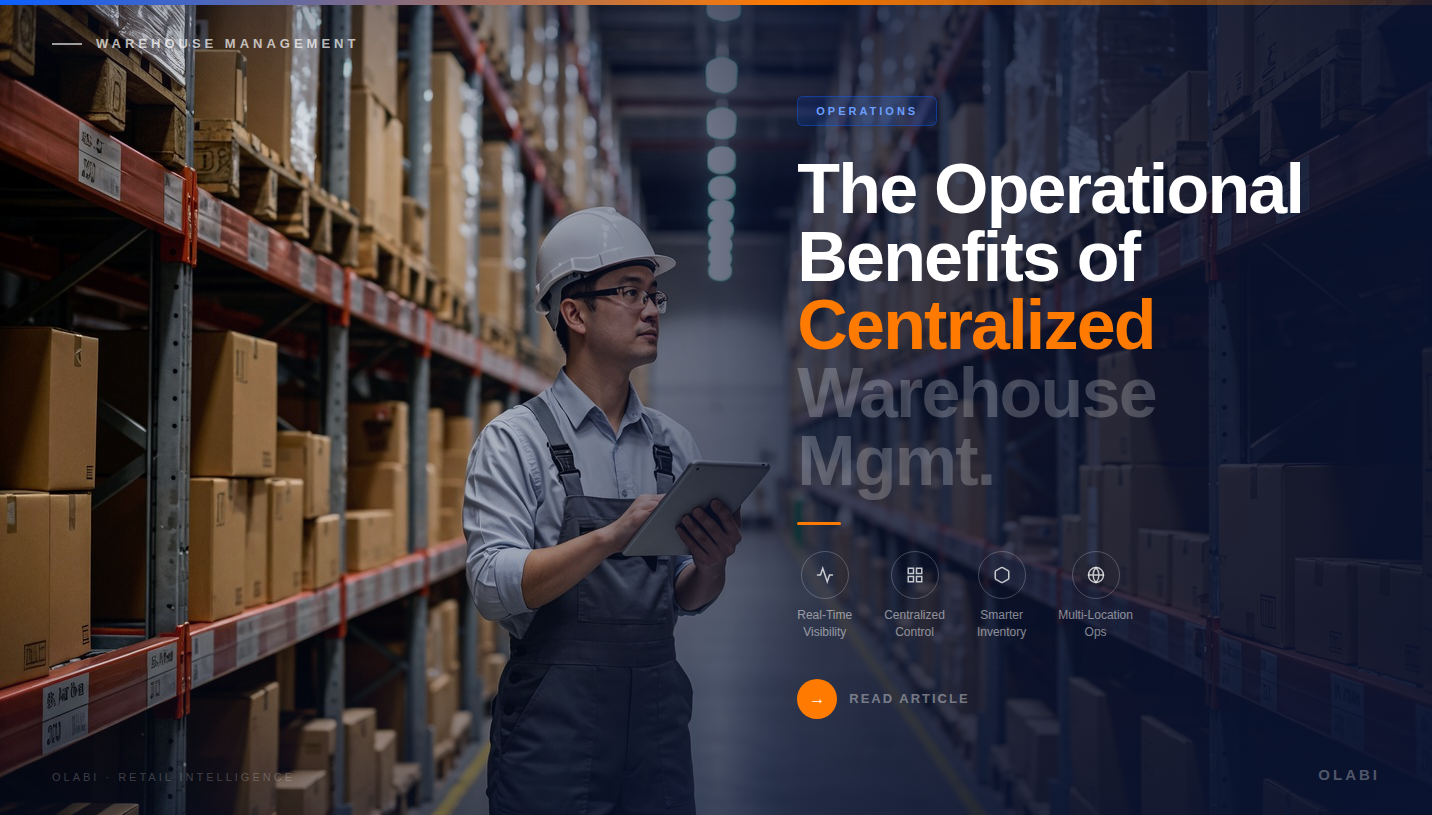
The Operational Benefits of Centralized Warehouse Management.
Warehouse operations are no longer just backend support functions in retail.
Today, they directly influence inventory availability, fulfillment speed, operational efficiency, and customer experience across every retail channel. As modern retail operations become more connected, warehouse management plays a much bigger role in maintaining smooth and scalable retail execution.
Retailers now manage inventory simultaneously across physical stores, eCommerce platforms, marketplaces, warehouses, and omnichannel fulfillment networks. As operations scale, maintaining inventory accuracy and operational coordination becomes significantly more challenging.
Many retailers still operate with fragmented warehouse systems and disconnected inventory workflows. This often leads to inventory mismatches, delayed replenishment, slower fulfillment cycles, poor stock visibility, and operational inefficiencies across the retail ecosystem.
And these problems become even more visible during high-demand periods, omnichannel fulfillment operations, and rapid retail expansion.
This is why centralized warehouse management is becoming increasingly important for modern retail businesses.
Instead of operating warehouses independently, retailers are moving toward connected warehouse infrastructure that enables centralized inventory visibility, faster operational coordination, and streamlined fulfillment management across locations and channels.
In modern retail, warehouse efficiency is no longer only about storage and dispatch.
It has become a critical operational capability that directly impacts retail scalability, inventory movement, omnichannel performance, and customer satisfaction.
What is Centralized Warehouse Management?
Centralized warehouse management is a unified approach where retailers manage inventory visibility, fulfillment workflows, replenishment operations, and warehouse coordination through a connected operational system instead of operating warehouses independently.
In many traditional retail environments, warehouse operations often function in silos. Different locations may operate with disconnected inventory visibility, delayed stock updates, fragmented replenishment processes, and isolated operational workflows. As retail operations expand across stores, warehouses, marketplaces, and digital channels, these disconnected systems create operational inefficiencies that slow down retail execution.
Centralized warehouse management solves this by bringing warehouse operations under a single connected framework.
Instead of managing inventory movement and warehouse coordination separately across locations, retailers gain centralized visibility into stock availability, fulfillment activities, replenishment workflows, and inventory movement across the entire retail network.
This helps retailers simplify operational coordination while improving inventory accuracy, fulfillment efficiency, and real-time operational visibility across channels.
Modern centralized warehouse management systems also help retailers improve synchronization between:
- warehouses,
- stores,
- eCommerce platforms,
- marketplaces,
- and omnichannel fulfillment operations.
As retail operations become more connected, centralized warehouse management is becoming increasingly important for maintaining operational agility and inventory efficiency across the retail ecosystem.
Why Retailers Are Moving Toward Centralized Warehouse Management
Retail operations today are significantly more complex than they were a few years ago.
Retailers are no longer managing only physical stores and warehouse dispatch operations. Modern retail businesses simultaneously handle eCommerce fulfillment, marketplace orders, omnichannel inventory movement, store replenishment, returns management, and cross-channel inventory coordination.
This operational complexity is one of the major reasons retailers are moving toward centralized warehouse management.
Omnichannel retail growth has increased the pressure on warehouse operations to become faster, more connected, and operationally synchronized across every channel. Customers now expect quicker deliveries, accurate inventory visibility, and seamless fulfillment experiences regardless of where they shop.
At the same time, retailers are managing inventory across multiple warehouses, stores, fulfillment hubs, and digital commerce platforms simultaneously.
Fragmented warehouse systems struggle to support this level of operational coordination efficiently.
Disconnected warehouse environments often slow down:
- inventory movement,
- replenishment cycles,
- order fulfillment,
- inventory synchronization,
- and overall operational scalability.
For example, delayed stock updates between warehouses and stores can create inventory mismatches, slower replenishment decisions, and fulfillment inefficiencies across the retail network.
As retail businesses scale across locations and channels, these operational gaps become increasingly difficult to manage.
This is why centralized warehouse management is becoming a critical operational strategy for modern retailers.
By creating connected warehouse operations with centralized visibility and coordination, retailers can improve inventory movement, simplify fulfillment workflows, strengthen replenishment planning, and support more scalable omnichannel retail operations across the business.
Improved Inventory Visibility Across Operations
One of the biggest operational advantages of centralized warehouse management is improved inventory visibility across the retail ecosystem.
Modern retailers manage inventory across multiple warehouses, stores, fulfillment hubs, marketplaces, and eCommerce channels simultaneously. Without connected visibility, tracking inventory movement accurately becomes difficult, especially as operations scale across locations and channels.
Many retailers still operate with fragmented warehouse systems where stock updates, replenishment information, and inventory movement are not synchronized in real time. This often creates inventory blind spots that lead to stock discrepancies, delayed replenishment decisions, fulfillment inefficiencies, and poor inventory coordination across the business.
Centralized warehouse management solves this by creating a connected operational environment where retailers gain real-time visibility into inventory movement across warehouses, stores, and fulfillment channels.
Instead of relying on disconnected inventory updates from multiple systems, retailers can monitor stock availability, inventory transfers, replenishment workflows, and fulfillment operations through centralized visibility.
This improves inventory coordination significantly.
For example, retailers can identify:
- slow-moving inventory,
- low-stock situations,
- replenishment requirements,
- and inventory imbalances
much faster across the network.
Better inventory visibility also enables faster operational decision-making.
Retail teams can respond quicker to changing demand patterns, optimize stock movement between locations, improve replenishment planning, and reduce inventory discrepancies before they impact customer experience or fulfillment operations.
This becomes even more important in omnichannel retail environments.
Modern consumers expect inventory availability across stores, websites, marketplaces, and fulfillment channels to remain accurate and synchronized in real time. Disconnected warehouse visibility often creates issues where inventory appears available in one channel but is unavailable operationally during fulfillment.
Centralized warehouse management helps retailers maintain connected inventory visibility across the retail ecosystem, enabling smoother omnichannel operations and better inventory accuracy across every touchpoint.
Faster and More Efficient Order Fulfillment
Order fulfillment speed has become a major operational priority in modern retail.
Customers today expect faster deliveries, real-time order updates, and seamless fulfillment experiences across every channel. At the same time, retailers are managing increasing order volumes across stores, eCommerce platforms, marketplaces, and omnichannel fulfillment networks simultaneously.
Without connected warehouse operations, fulfillment coordination becomes significantly more difficult.
Disconnected warehouse systems often create delays in inventory allocation, dispatch workflows, stock movement, and order processing. This slows down fulfillment operations and creates operational bottlenecks during high-demand periods.
Centralized warehouse management helps retailers improve fulfillment efficiency by creating connected visibility across warehouse operations, inventory availability, and fulfillment workflows.
With centralized operational coordination, retailers can process orders faster, improve dispatch planning, and reduce delays caused by fragmented warehouse environments.
This becomes especially important for handling:
- omnichannel fulfillment,
- marketplace orders,
- store replenishment,
- and seasonal demand spikes.
For example, during festive or promotional sales periods, retailers often experience sudden increases in order volumes across multiple channels simultaneously. Retailers operating with disconnected warehouse systems may struggle with delayed stock updates, slower dispatch coordination, and fulfillment inefficiencies during these high-demand periods.
Centralized warehouse management helps retailers maintain better operational visibility during peak demand situations, enabling faster inventory allocation and smoother order fulfillment across the retail network.
As modern retail operations become increasingly omnichannel, connected warehouse coordination is becoming essential for maintaining fulfillment speed and operational efficiency.
Better Inventory Accuracy and Replenishment Coordination
Inventory accuracy plays a critical role in both operational efficiency and customer experience.
Even small inventory mismatches can create fulfillment issues, delayed replenishment, stock discrepancies, and poor inventory visibility across retail operations.
Many retailers still operate with disconnected warehouse systems where inventory updates are delayed across locations and channels. This often creates situations where stock appears available operationally but is unavailable during actual fulfillment or replenishment processes.
These inconsistencies affect:
- order fulfillment accuracy,
- replenishment planning,
- inventory coordination,
- and overall retail execution.
Centralized warehouse management improves inventory synchronization by creating connected visibility across warehouses, stores, and fulfillment channels.
Instead of managing stock movement through isolated operational systems, retailers gain real-time visibility into inventory availability, replenishment requirements, and stock movement across the retail ecosystem.
This helps improve replenishment coordination significantly.
Retailers can identify low-stock situations faster, optimize inventory movement between locations, and improve replenishment planning before inventory gaps begin affecting sales or fulfillment operations.
Inventory accuracy also directly impacts customer experience.
In omnichannel retail environments, customers expect inventory visibility across online and offline channels to remain accurate in real time. Delayed stock synchronization can create canceled orders, fulfillment delays, and poor customer experiences.
Centralized warehouse management helps retailers maintain more accurate inventory visibility while improving operational coordination across the business.
As retail operations scale across channels and locations, connected inventory synchronization is becoming increasingly important for maintaining both operational efficiency and customer trust.
Stronger Omnichannel Retail Operations
Modern retail operations depend heavily on connected omnichannel coordination.
Customers today expect seamless shopping experiences across stores, eCommerce platforms, marketplaces, and fulfillment channels. They expect inventory availability to remain accurate in real time regardless of where they shop.
This creates significant operational pressure on warehouse operations.
Centralized warehouse management helps retailers support stronger omnichannel retail operations by enabling real-time stock synchronization and unified inventory visibility across the retail ecosystem.
Instead of operating with disconnected warehouse environments, retailers gain centralized visibility into inventory movement, stock availability, fulfillment workflows, and replenishment coordination across channels.
This improves operational coordination between:
- stores,
- eCommerce platforms,
- marketplaces,
- and fulfillment operations.
For example, inventory movement between warehouses and retail stores becomes faster and more synchronized, helping retailers fulfill orders more efficiently while maintaining better stock visibility across channels.
Warehouse coordination also plays a critical role in ensuring that omnichannel fulfillment operations remain smooth during periods of high order volumes, promotional sales, and seasonal demand spikes.
As omnichannel retail continues expanding, connected warehouse operations are becoming increasingly important for maintaining inventory accuracy, fulfillment efficiency, and operational agility across the business.
Reduced Operational Complexity
Warehouse operations become significantly more difficult to manage as retail businesses scale across locations and channels.
Retailers managing multiple warehouses, stores, fulfillment centers, and digital commerce operations often struggle with fragmented operational workflows, disconnected reporting systems, and inconsistent inventory visibility across the network.
Centralized warehouse management helps simplify these operational challenges by creating centralized control over warehouse coordination, inventory tracking, operational workflows, and reporting visibility.
Instead of managing warehouse operations separately across locations, retailers can monitor inventory movement, replenishment activities, fulfillment coordination, and warehouse performance through a connected operational environment.
This reduces operational silos while improving coordination across teams and retail functions.
Centralized operational control becomes especially important as retailers expand across:
- multiple stores,
- warehouses,
- marketplaces,
- and omnichannel fulfillment channels.
Without centralized warehouse management, fragmented warehouse systems often create:
- delayed inventory updates,
- inconsistent stock visibility,
- slower replenishment cycles,
- fulfillment inefficiencies,
- and operational bottlenecks.
Over time, these inefficiencies increase operational complexity and make retail execution significantly harder to scale efficiently.
Centralized warehouse management helps retailers simplify warehouse operations while improving visibility, coordination, and operational consistency across the retail ecosystem.
Better Scalability for Growing Retail Businesses
As retail businesses expand across stores, warehouses, regions, and fulfillment networks, operational complexity increases rapidly.
Managing inventory movement, replenishment coordination, fulfillment operations, and warehouse visibility across multiple locations becomes difficult when warehouse systems operate independently. This often creates inconsistencies in operational workflows, delayed coordination, and fragmented inventory visibility across the retail network.
Centralized warehouse management helps retailers scale operations more efficiently by creating standardized workflows, centralized operational visibility, and connected warehouse infrastructure across locations.
Instead of managing warehouse operations separately for every region or facility, retailers can maintain centralized control over inventory tracking, replenishment coordination, warehouse performance, and fulfillment activities through a connected operational system.
This becomes especially important for retailers expanding warehouse operations across multiple cities or regions.
For example, a fashion retailer expanding fulfillment and warehouse operations nationally requires consistent inventory visibility and operational coordination across every location. Without centralized warehouse management, maintaining operational consistency across the network becomes increasingly difficult as the business grows.
Connected warehouse infrastructure helps retailers scale operations while maintaining:
- standardized workflows,
- better inventory coordination,
- centralized reporting,
- and operational consistency across locations.
As modern retail operations become increasingly omnichannel and geographically distributed, centralized warehouse management is becoming an important part of scalable retail infrastructure.
The Role of Technology in Centralized Warehouse Management
Modern warehouse management systems play a major role in enabling centralized warehouse management.
Retailers today require faster inventory visibility, connected operational coordination, and real-time warehouse tracking across multiple locations and channels. Managing these operations manually or through disconnected systems creates operational inefficiencies that slow down retail execution.
Modern warehouse management technology helps retailers improve:
- real-time inventory tracking,
- warehouse automation,
- centralized operational visibility,
- and connected retail coordination.
Cloud-based warehouse infrastructure enables retailers to monitor inventory movement, fulfillment workflows, replenishment activities, and warehouse operations through connected systems that support real-time operational visibility across the business.
This also improves synchronization between:
- warehouses,
- stores,
- eCommerce platforms,
- marketplaces,
- and omnichannel fulfillment operations.
As retail operations continue becoming more connected and inventory movement becomes faster across channels, cloud-based warehouse infrastructure is becoming increasingly important for maintaining operational agility and scalable retail coordination.
Modern retail businesses require warehouse systems that can support connected operations, faster fulfillment, and centralized visibility without increasing operational complexity as the business grows.
The Future of Retail Operations is Connected and Centralized
Modern retail operations are becoming increasingly connected, fast-moving, and operationally complex.
Retailers today manage inventory movement, fulfillment operations, replenishment coordination, and customer demand simultaneously across stores, warehouses, marketplaces, eCommerce platforms, and fulfillment networks. As retail ecosystems continue expanding, disconnected operational environments are becoming harder to manage efficiently.
This is why the future of retail operations increasingly depends on:
- connected inventory visibility,
- centralized operational control,
- faster fulfillment,
- and stronger omnichannel coordination.
Retailers can no longer rely on fragmented warehouse systems and isolated operational workflows to support scalable retail growth. Modern retail requires connected infrastructure that enables inventory visibility and operational coordination across every retail touchpoint in real time.
Centralized warehouse management plays a critical role in enabling this operational transformation.
By creating connected warehouse operations with centralized visibility and synchronized workflows, retailers can improve inventory movement, strengthen fulfillment efficiency, simplify replenishment planning, and maintain better operational control across the business.
As omnichannel retail operations continue growing, centralized warehouse management is becoming an essential operational capability for future-ready retail businesses looking to improve agility, scalability, and connected retail execution.
Warehouse operations are no longer functioning only as backend infrastructure.
They are becoming a core part of modern retail performance and omnichannel operational efficiency.
Conclusion
Warehouse operations are no longer functioning as isolated backend processes in modern retail.
They now directly influence inventory visibility, fulfillment speed, replenishment efficiency, operational coordination, and overall customer experience across every retail channel. As retailers continue expanding across stores, warehouses, marketplaces, eCommerce platforms, and omnichannel fulfillment networks, maintaining connected and scalable warehouse operations becomes significantly more important.
This is where centralized warehouse management creates long-term operational value.
By enabling connected inventory visibility, centralized operational control, faster fulfillment coordination, and streamlined replenishment workflows, centralized warehouse management helps retailers improve operational efficiency while reducing complexity across the retail ecosystem.
It allows retailers to move inventory faster, improve fulfillment accuracy, strengthen omnichannel operations, and maintain better operational consistency as the business scales across locations and channels.
Modern retail businesses require more than warehouse storage and dispatch capabilities.
They require connected warehouse infrastructure that supports real-time operational visibility, scalable fulfillment operations, and seamless inventory coordination across the entire retail network.
At Olabi, we help retailers simplify and strengthen warehouse operations through connected retail infrastructure built for modern omnichannel retail environments. From centralized inventory visibility and replenishment coordination to fulfillment management and operational synchronization, our platform enables retailers to build more agile, scalable, and connected retail operations.
If your retail business is looking to improve inventory efficiency, fulfillment coordination, and operational scalability, schedule a demo with Olabi and explore how centralized warehouse management can help build smarter and more connected retail operations.
Share This Story, Choose Your Platform!
About the Author: Olabi

