
Olabi Sutras
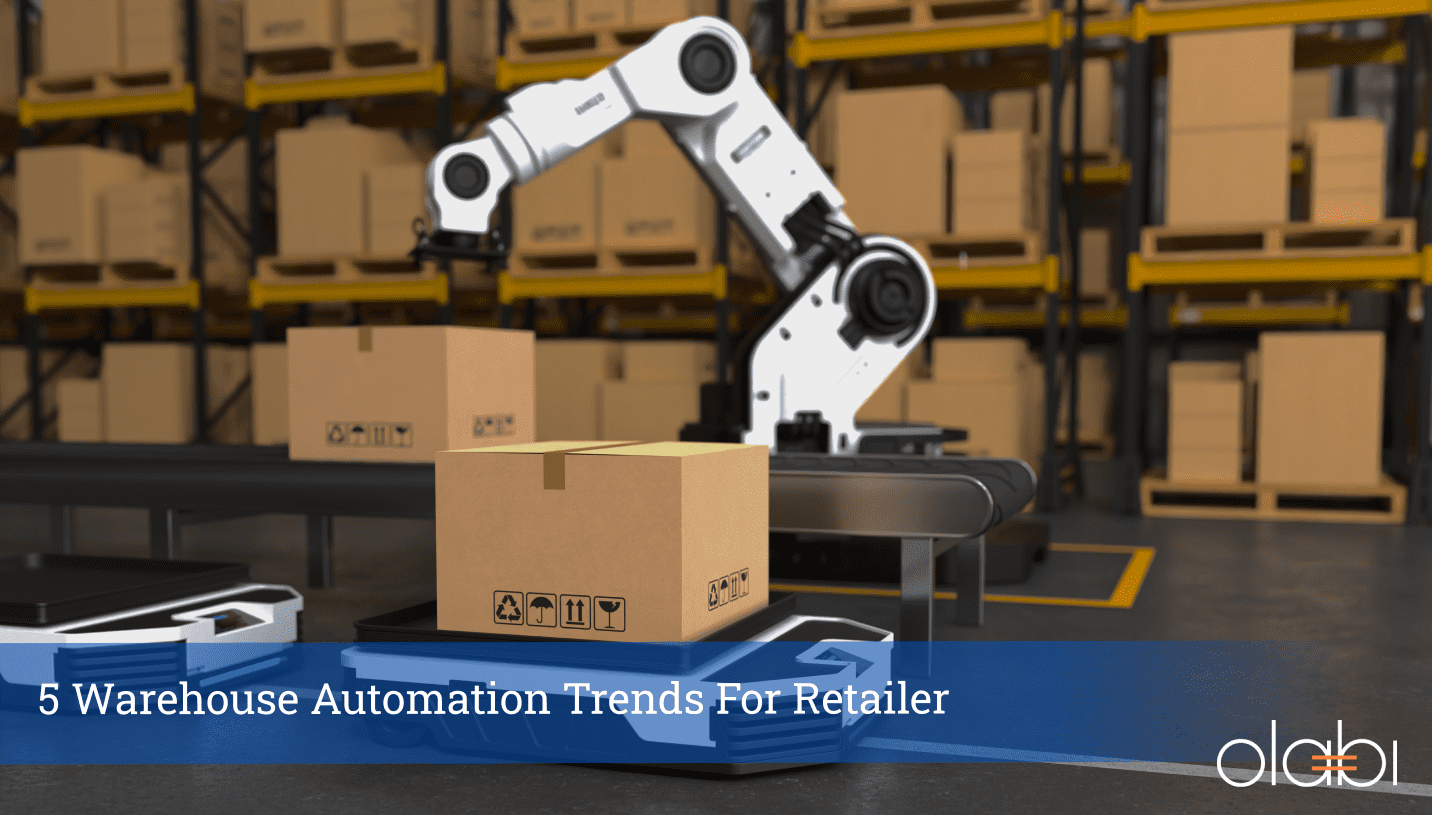
5 Warehouse Automation Trends Every Retailer Should Watch
Warehousing has become the backbone of modern retail operations, especially with the surge in e-commerce and omnichannel shopping. Retailers today are under constant pressure to process orders faster, reduce errors, and optimize costs, all while managing ever-growing product assortments. Traditional manual processes can no longer keep pace with these demands.
This is where warehouse automation comes in. From robotics and IoT-enabled tracking to AI-driven forecasting, automation technologies are transforming warehouses into high-efficiency hubs. Retailers who embrace these innovations are not only improving accuracy and speed but also gaining a competitive edge in customer experience.
In this blog, we’ll explore five key warehouse automation trends every retailer should watch to stay ahead in 2025 and beyond.
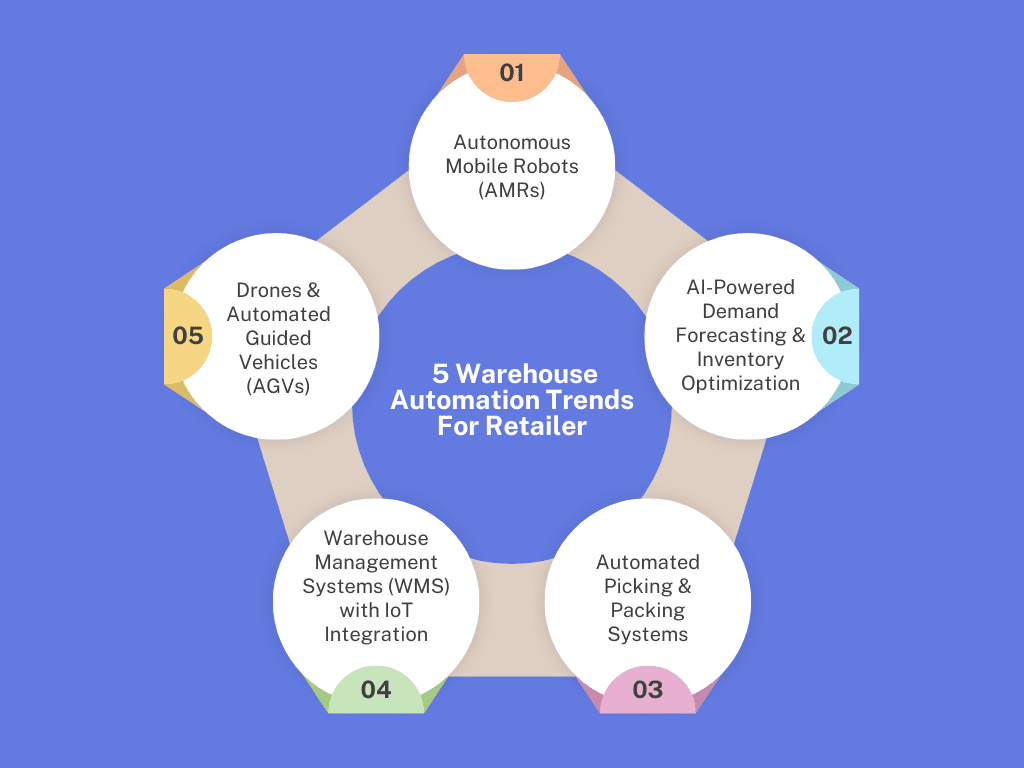
1. Autonomous Mobile Robots (AMRs)
Autonomous Mobile Robots (AMRs) are among the most impactful innovations transforming warehouse operations. Unlike fixed conveyor systems or Automated Guided Vehicles (AGVs) that require pre-set paths, AMRs are equipped with advanced sensors, AI-based navigation, and real-time mapping capabilities. This allows them to move freely across the warehouse, dynamically adjusting to layouts, obstacles, and workflow changes.
Their primary role lies in picking, sorting, and transporting goods, tasks that traditionally consume significant manpower and time. By handling these repetitive activities, AMRs reduce dependency on manual labor, accelerate order fulfillment, and improve overall accuracy. This not only lowers operational costs but also enables staff to focus on higher-value activities such as quality checks and exception management.
The benefits extend beyond efficiency. AMRs improve scalability, as additional units can be deployed during peak seasons without major infrastructure changes. They also optimize warehouse space utilization by minimizing the need for wide aisles or fixed transport systems.
Use case: In the fashion and lifestyle sector, warehouses often deal with thousands of SKUs spread across different sizes, colors, and seasonal collections. AMRs can quickly locate and move specific items to packing or dispatch areas, ensuring faster turnaround times and fewer errors. This capability is particularly valuable for retailers managing omnichannel operations, where speed and accuracy directly impact customer satisfaction.
2. AI-Powered Demand Forecasting & Inventory Optimization
Artificial Intelligence (AI) and Machine Learning (ML) are reshaping the way retailers manage demand forecasting and inventory planning. Traditional forecasting methods, often based on historical sales data and fixed seasonal patterns, struggle to capture today’s complex buying behaviors. AI-powered systems, on the other hand, analyze a wide range of variables, past sales, market trends, promotions, seasonality, and even external factors like weather or local events, to deliver far more accurate predictions.
With these insights, retailers can achieve real-time inventory monitoring and dynamically adjust stock levels to match demand. This minimizes costly challenges such as stockouts, which lead to missed sales, and overstocking, which ties up capital and warehouse space. The result is a more balanced, data-driven approach to inventory management.
The impact goes beyond just shelf availability. Smarter forecasting supports better procurement planning, allowing retailers to negotiate with suppliers based on actual demand projections. It also helps optimize warehouse space utilization, as stock can be aligned more closely with turnover rates instead of relying on guesswork.
Use case: In lifestyle and fashion retail, demand often fluctuates based on fast-changing trends, influencer-driven spikes, and seasonal shifts. AI models can predict which sizes, colors, or styles are likely to perform well in a given region or sales channel, ensuring that warehouses are stocked precisely with what customers want. This reduces dead stock, shortens fulfillment cycles, and enhances overall profitability.
3. Automated Picking & Packing Systems
As order volumes surge in retail, especially with the rise of e-commerce, manual picking and packing processes can quickly become a bottleneck. To address this, many warehouses are adopting automated picking and packing systems powered by robotics and intelligent technologies.
These systems combine conveyor belt automation, robotic arms, and smart scanners to streamline repetitive tasks. Robotic arms can pick items from shelves with precision, scanners ensure the right product is selected, and conveyors transport goods seamlessly to packing stations. Once at the packing area, automated systems can measure, package, and even label items, ensuring consistency and reducing human error.
The benefits are substantial:
- Speed – Orders are processed faster, helping retailers meet same-day or next-day delivery expectations.
- Consistency – Automation guarantees accuracy and uniformity in packing, enhancing customer satisfaction.
- Reduced dependency on manual labor – This helps retailers overcome workforce shortages, particularly during peak seasons.
Use case: High-volume fashion warehouses, where hundreds of orders may need to be picked within hours, benefit greatly from automation. Instead of relying on large picking teams, robotic systems can handle bulk operations efficiently, freeing human staff for value-added tasks like quality checks or handling exceptions. This ensures quicker turnaround times while maintaining accuracy across thousands of SKUs.
4. Warehouse Management Systems (WMS) with IoT Integration
Modern Warehouse Management Systems (WMS) are becoming the digital backbone of warehouse operations, and their capabilities are expanding rapidly with IoT integration. By embedding IoT sensors throughout the warehouse, on shelves, pallets, or even individual products, retailers gain real-time stock visibility. This eliminates blind spots and ensures that every item can be tracked accurately from arrival to dispatch.
When paired with a cloud-based WMS, IoT devices feed live data into a centralized system, allowing seamless flow of information across procurement, inventory, and sales channels. This integration ensures that managers and frontline staff always work with up-to-date information, improving decision-making and reducing delays caused by outdated records.
The advantages are clear:
- Traceability – End-to-end product tracking supports recall processes and strengthens customer trust.
- Compliance – Automated data capture helps meet regulatory requirements for labeling, safety, and audits.
- Efficient space utilization – Real-time insights into stock levels and movement patterns allow better organization of warehouse layouts and reduce wasted space.
Use case: In fashion and lifestyle retail, where stock often includes seasonal collections and perishable trends, IoT-enabled WMS ensures precise inventory tracking across multiple stores and warehouses. A retailer can, for instance, instantly see where a particular SKU is located, how fast it’s moving, and whether it needs to be replenished, enabling faster response to customer demand both online and offline.
5. Drones & Automated Guided Vehicles (AGVs)
Two technologies making a significant impact in large-scale warehouse automation are drones and Automated Guided Vehicles (AGVs). While both serve different purposes, together they contribute to faster, safer, and more efficient warehouse operations.
Drones are increasingly used for stocktaking and high-rack scanning. Equipped with cameras and RFID readers, they can quickly scan barcodes or tags on shelves that are otherwise difficult for human staff to reach. This reduces the time required for inventory audits from days to hours while also improving accuracy.
AGVs, on the other hand, are designed for pallet movement and heavy load transport. They follow pre-set paths or advanced navigation systems to move goods between storage areas, packing stations, and loading docks. By automating these physically demanding tasks, AGVs minimize the risk of workplace injuries and free up human staff for supervisory or exception-based roles.
The combined benefits include:
- Improved safety – Reducing manual lifting and high-rack climbing lowers accident risks.
- Reduced downtime – Continuous, automated movement of goods ensures smooth workflow without bottlenecks.
- Higher efficiency – Tasks like stock audits and pallet transfers are completed faster and more consistently.
Use case: For fashion retailers managing massive distribution centers with towering racks of apparel cartons, drones can complete stock verification at scale, while AGVs handle the constant movement of pallets to and from dispatch zones. Together, they keep the warehouse running with minimal interruptions and maximum accuracy.
Challenges & Considerations in Warehouse Automation
While warehouse automation delivers significant benefits, retailers must also be mindful of the challenges that come with adopting these technologies.
High Initial Investment – Deploying robots, drones, or advanced WMS platforms often requires substantial upfront capital. For many retailers, especially mid-sized businesses, the return on investment may take time to realize. Careful cost-benefit analysis is essential before scaling automation projects.
Workforce Reskilling – Automation shifts the role of warehouse automation staff from manual tasks to supervisory, technical, and analytical functions. This transition demands investment in training programs to equip employees with new skills, ensuring they remain productive in a tech-driven environment.
Data Security & System Integration – Cloud-based WMS, IoT devices, and AI forecasting systems rely heavily on interconnected data. This increases the risk of cyberattacks and system vulnerabilities if not managed properly. Seamless integration between legacy systems and modern warehouse automation tools is also a critical hurdle many retailers face.
By addressing these challenges proactively, with phased adoption, training initiatives, and robust cybersecurity measures, retailers can maximize the value of automation while minimizing potential risks.
Conclusion
Warehouse automation is no longer a futuristic concept, it is a present-day necessity for retailers striving to meet the demands of e-commerce and omnichannel operations. From Autonomous Mobile Robots (AMRs) and AI-powered forecasting to robotic picking systems, IoT-enabled WMS, and drones with AGVs, each of these five trends highlights how technology is reshaping the backbone of retail logistics.
Retailers who embrace these innovations today are positioning themselves for greater scalability, operational efficiency, and long-term competitiveness. Beyond cutting costs and reducing errors, automation ensures faster fulfillment, improved accuracy, and the ability to deliver seamless customer experiences.
As the retail landscape continues to evolve, now is the time to explore warehouse automation solutions, whether through phased adoption or full-scale transformation. Those who act early will be best equipped to stay ahead of customer expectations and industry shifts.
Schedule a demo with Olabi and discover how futuristic retail technology can transform your business.
Share This Story, Choose Your Platform!
About the Author: Olabi

