
Olabi Sutras
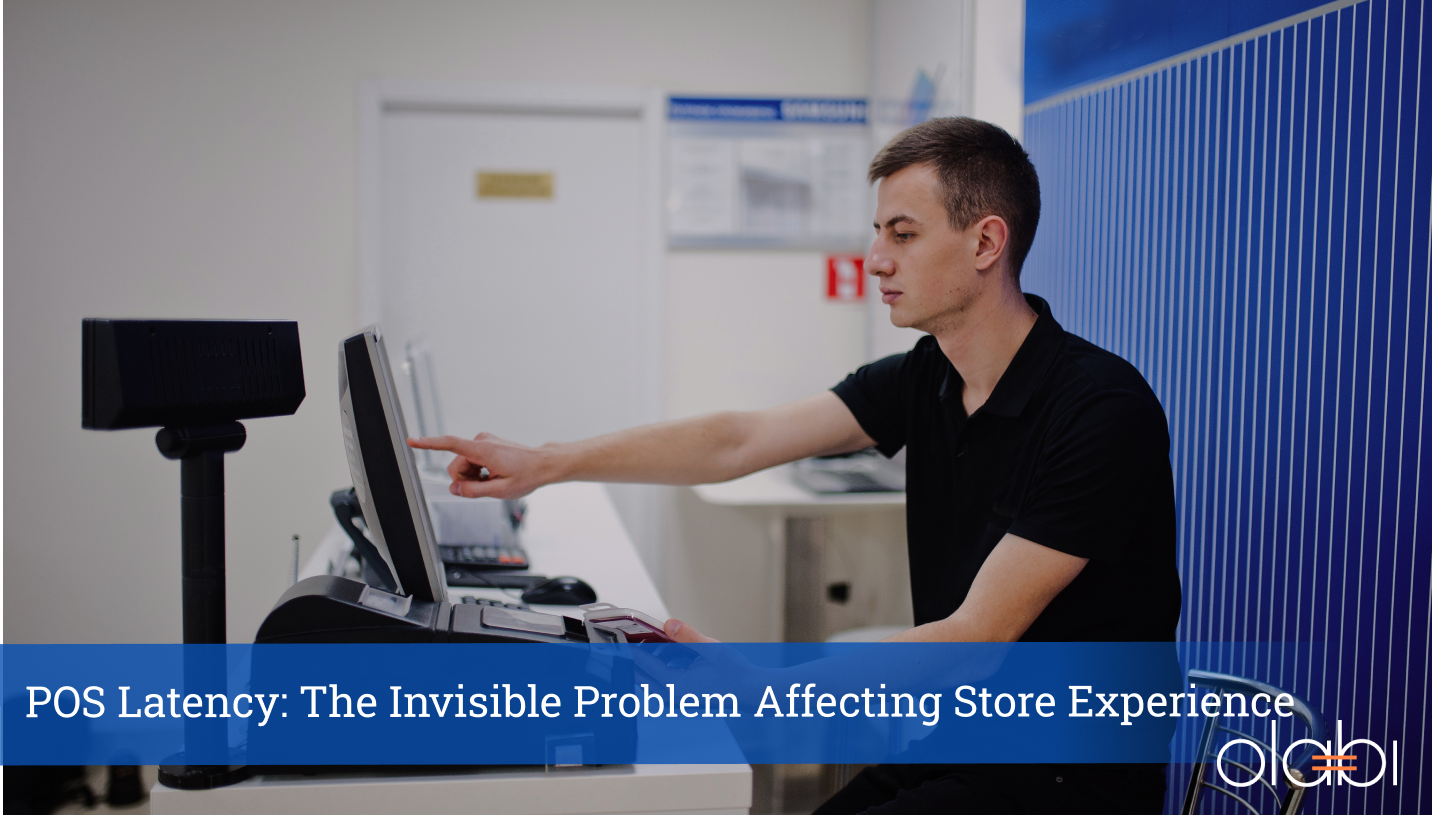
POS Latency: The Invisible Problem Affecting Store Experience
Retail leaders invest heavily in store design, merchandising, and customer experience. The focus is often on what the customer can see and feel, layout, product placement, service quality.
But one of the most critical parts of the in-store journey is almost invisible: the speed of the system at checkout.
A transaction that takes a few extra seconds may not seem like a failure. There are no crashes, no obvious errors. The system works. The sale goes through.
And yet, those small delays accumulate, especially during peak hours, creating longer queues, increasing customer frustration, and reducing store efficiency.
This is the problem of POS latency.
It rarely shows up in reports, but it is consistently experienced on the ground.
What is POS Latency?
POS latency refers to the delay between a user action and the system’s response at the point of sale.
In a retail environment, this can occur at multiple stages of a transaction:
- When an item is scanned and the system takes time to reflect it in the cart
- When pricing, discounts, or taxes take time to calculate
- When payment processing is delayed due to external integrations
- When the system takes time to generate receipts or update inventory
Importantly, latency is not the same as a system failure.
The system is functional, but not responsive.
This distinction matters. Because while failures are visible and urgent, latency is subtle. It slows down operations without triggering immediate action, making it harder to detect and address.
Why POS Latency Is Often Ignored
Despite its impact, POS latency is rarely treated as a priority in retail operations.
One reason is that it does not appear clearly in standard reports. Retail dashboards focus on sales, conversion rates, and inventory, not on milliseconds of delay during transactions.
There is also a lack of clear ownership. Is latency an IT issue, an operations problem, or a vendor limitation? In many cases, it falls between teams and remains unaddressed.
At the store level, staff often adapt to the system’s speed. What should be considered slow becomes normalized over time. Delays are accepted as “how the system works.”
As a result, POS latency becomes an invisible inefficiency, one that quietly affects both customer experience and store performance without drawing attention.
Where Latency Actually Occurs (A Ground-Level View)
POS latency is not a single-point issue. It is distributed across multiple steps in the transaction flow, each adding small delays that accumulate over time.
At the billing stage, latency often appears as a lag between scanning an item and it reflecting in the system. Even minor delays in price lookup or product retrieval can slow down the flow of billing, especially when multiple items are involved.
During checkout, the system processes cart-level calculations such as totals, discounts, and taxes. If these computations are not optimized, even a slight delay in recalculating the cart can disrupt the rhythm of the transaction.
At the payment stage, latency becomes more visible. Payment gateway response times, especially during peak hours, can introduce waiting periods. In cases of failure or retry, this delay is amplified, directly affecting both customer patience and staff efficiency.
Even post-transaction, latency continues to play a role. Delays in generating receipts or updating inventory systems may not be immediately visible to the customer, but they impact backend accuracy and operational flow.
Individually, these delays may seem negligible. Collectively, they create friction at every step of the checkout journey.
Real-World Impact on Store Experience
The effects of POS latency are subtle, but they are consistently felt across both customer and staff experiences.
From the customer’s perspective, latency translates into longer queues and slower-moving lines. Even when the delay is only a few seconds per transaction, it compounds during peak hours, leading to visible congestion. This creates a perception of inefficiency, regardless of how well the rest of the store is managed. Over time, repeated exposure to such friction can reduce overall satisfaction and willingness to return.
From the store staff’s perspective, latency directly affects productivity. Slower systems reduce transaction throughput, forcing staff to operate under increased pressure, especially during high-traffic periods. In response, staff often develop workaround behaviors, such as skipping steps, rushing interactions, or avoiding system-heavy processes, which can further impact accuracy and service quality.
The key challenge is that none of this appears as a system failure. Transactions are completed, sales are recorded, and operations continue.
However, the experience is gradually degraded, without triggering immediate concern or corrective action.
Business Impact, Where It Becomes Critical
The impact of POS latency extends far beyond minor inconvenience. At scale, it directly affects both revenue and brand perception.
One of the most immediate consequences is reduced checkout throughput. When each transaction takes longer than necessary, the number of customers that can be served within a given time window decreases. During peak hours, this creates a bottleneck at the point of sale.
This, in turn, leads to lost sales. Customers faced with long queues often abandon their purchases, especially when time is limited. Unlike online abandonment, this form of lost revenue is rarely tracked or quantified.
Latency also contributes to a form of in-store cart abandonment, where intent exists, but friction at checkout prevents conversion. Over time, repeated exposure to slow and inefficient billing experiences can shape negative brand perception, even if the rest of the retail experience is strong.
The long-term effect is a decline in repeat visits and customer loyalty. Customers may not explicitly identify latency as the issue, but they remember the experience.
At scale, the math becomes unavoidable:
small delays, multiplied by high transaction volumes, result in significant revenue loss.
Root Causes of POS Latency
POS latency is rarely caused by a single issue. It is typically the result of multiple underlying factors across technology, infrastructure, and system integrations.
From a technology perspective, poorly designed system architecture can introduce unnecessary complexity. Heavy or bloated POS applications increase processing time, while excessive API calls create dependencies that slow down response cycles. The absence of offline capability further compounds the issue, making the system entirely reliant on real-time connectivity.
On the infrastructure side, weak or unstable internet connectivity is a common contributor. Server response delays, especially in centralized systems, add latency to every transaction. The lack of edge or local processing means even simple operations depend on distant servers, increasing response time.
From an integration standpoint, modern retail systems often rely on multiple interconnected platforms. Real-time dependencies across inventory, pricing, and payment systems create multiple points of delay. Slow middleware or inefficient synchronization layers further amplify latency across the transaction flow.
These factors rarely exist in isolation. Together, they create a system that functions, but not at the speed required for efficient retail operations.
Why It Gets Worse at Scale
POS systems are often tested and validated under controlled or average conditions. However, retail operates under variable and often extreme demand patterns.
During peak hours, transaction volume increases significantly, placing higher load on systems that may not be designed to handle concurrency at scale. What appears as a minor delay under normal conditions becomes a visible bottleneck when multiplied across multiple transactions.
During festive periods or promotional events, system stress intensifies. Higher footfall, increased billing frequency, and simultaneous transactions expose performance limitations that remain hidden during regular operations.
In multi-store environments, the complexity increases further. Real-time synchronization across locations adds additional load to central systems, increasing the likelihood of latency.
The result is a common pattern:
systems that perform adequately under low or moderate load begin to degrade under real-world conditions.
Performance at scale, not just functionality, is what ultimately defines the effectiveness of a retail POS system.
What Retailers Should Measure – The Missing Metrics
One of the key reasons POS latency persists is that it is rarely measured in a structured way. Traditional retail metrics focus on outcomes, sales, conversion, and revenue, but overlook the performance of the transaction itself.
To address latency effectively, retailers need to track metrics that reflect system responsiveness at the point of sale.
This includes time per transaction, which measures the total duration from the first scan to the completion of billing. Breaking this down further, scan-to-bill completion time helps identify delays within the billing flow itself.
At the payment stage, payment processing time becomes critical. Variability here often indicates issues with external integrations or network dependencies.
Additionally, retailers should monitor system response time, the POS equivalent of Time to First Byte (TTFB). This reflects how quickly the system responds to each action, providing a direct view of performance efficiency.
These metrics shift the focus from outcomes to operational performance. Without them, latency remains anecdotal and unaddressed.
As the principle goes:
you can’t fix what you don’t measure.
How to Fix POS Latency- A High-Level Approach
Addressing POS latency requires a combination of system design, architectural decisions, infrastructure readiness, and operational discipline.
From a system design perspective, simplicity is critical. A lightweight POS interface reduces processing overhead and improves responsiveness. Eliminating unnecessary dependencies, especially those that trigger external calls during transactions, helps streamline the flow.
At the architecture level, adopting an offline-first approach can significantly reduce reliance on real-time connectivity. Enabling local processing for core functions such as billing ensures that transactions remain fast and reliable, even under network constraints.
On the infrastructure side, stable and high-quality network connectivity is essential. Equally important is a scalable backend that can handle peak loads without degradation in performance.
From an operations standpoint, performance should be actively monitored rather than assumed. Regular tracking of transaction times and system response metrics helps identify issues early. Additionally, conducting stress tests during peak scenarios, such as sales events or high-footfall periods, ensures the system is prepared for real-world conditions.
Improving POS performance is not a one-time fix. It requires ongoing attention across technology and operations.
Conclusion
Retail experience rarely breaks in obvious ways. There are no alerts, no system failures, no clear signals that something is wrong. Instead, it erodes gradually, through small, repeated friction points that accumulate over time.
POS latency is one of those friction points. It is rarely visible in reports, rarely escalated as an issue, and often accepted as part of daily operations. Yet its impact is consistently felt, at the billing counter, in customer perception, and in store efficiency.
What makes it critical is not the magnitude of a single delay, but the frequency with which it occurs. Across hundreds or thousands of transactions, even minor latency becomes a measurable business cost.
For retailers, this shifts the conversation from functionality to performance. A system that works is no longer enough. It must work fast, consistently, and at scale.
Speed at checkout is not just a technical metric.
It is a defining part of the customer experience and increasingly, a competitive advantage.
If you’re evaluating how your current POS performs under real-world conditions, it may be time to take a closer look.
At Olabi, we focus on building high-performance retail systems designed for speed, reliability, and scale.
Schedule a demo to see how Olabi can help you eliminate latency and deliver a faster, more efficient in-store experience.
Share This Story, Choose Your Platform!
About the Author: Olabi

