
Olabi Sutras
Promotion Cannibalization: When Discounts Shift Rather Than Grow Sales
Promotions are designed to drive sales, attract customers, and encourage additional purchases. But an increase in promotional sales does not always mean the retailer has generated new demand.
Sometimes, customers simply change what, where, or when they buy because of the promotion. A customer who would have purchased a full-price product may switch to a discounted alternative. Similarly, a promotion on one category may shift spending away from another category, or customers may bring forward purchases they would have made later.
For example, a retailer may offer a 30% discount on a premium shirt. Sales of that shirt increase significantly, but sales of a similar full-price shirt decline. The promotion has increased sales for one product, but some of that growth has come from another product rather than from new customer demand.
This phenomenon is known as promotion cannibalization.
Understanding it is important because retailers need to distinguish between genuine incremental sales and sales that have simply shifted from somewhere else. Without this distinction, a promotion can appear successful while contributing less additional revenue or margin, than expected.
What Is Promotion Cannibalization?
Promotion cannibalization occurs when a promotion increases sales of a particular product, category, or channel but reduces sales of another related product, category, or channel.
Instead of creating entirely new demand, the promotion can cause customers to switch their existing purchases toward the discounted option.
For example, imagine a retailer sells two similar products:
- Product A: Premium shirt — ₹2,500
- Product B: Regular shirt — ₹1,800
The retailer offers 30% off Product A. Sales of Product A increase, but some customers who would normally have purchased Product B now choose the discounted premium shirt.
Product A has gained sales, but part of that increase has come at the expense of Product B.
Sales Growth vs. Sales Shifting
This distinction is critical when evaluating promotions.
Sales growth means the promotion generates purchases that would not have happened otherwise.
Sales shifting means customers who were already likely to purchase simply change the product, category, store, or timing of their purchase.
The result can be misleading. A retailer may see a significant increase in sales for the promoted SKU and assume the campaign generated strong incremental demand. However, when the performance of related products or the overall category is considered, the actual increase may be much smaller.
That is why promotion performance should be evaluated beyond the promoted product alone. Retailers need to understand what happened across the surrounding product mix to determine whether a promotion truly grew the business or simply shifted existing demand.
How Promotion Cannibalization Happens
Promotion cannibalization can occur in several ways, depending on what customers are switching from and what they are switching to.
Product-to-Product
A discount on one SKU can take sales away from another similar product. For example, a 20% discount on a premium T-shirt may encourage customers to choose it instead of a regular-priced T-shirt they would have purchased.
Category-to-Category
Promotions can also shift spending between categories. A strong offer on footwear, for example, may increase footwear sales while reducing the amount customers spend on apparel during the same visit.
Store-to-Store
A promotion available at one store can shift purchases away from another nearby location. Overall network sales may change very little even though the promoted store records significant growth.
Time-to-Time
Promotions can influence when customers make a purchase. A customer who planned to buy a product next month may purchase it during this month’s promotion. Sales increase during the campaign, but some of that demand has simply moved forward.
Full-Price-to-Discount
One of the most important forms of promotion cannibalization occurs when customers who would have purchased at full price end up purchasing at a discount.
The retailer generates a sale, but gives away part of the margin unnecessarily. In this case, the promotion may increase promotional sales without creating meaningful incremental demand.
The Difference Between Promotional Sales and Incremental Sales
Promotional sales are not necessarily incremental sales.
A retailer needs to understand how much of the sales generated during a promotion represents additional demand and how much would have occurred anyway.
A simple way to look at this is:
Total Promotional Sales → Baseline Sales → Incremental Sales
Baseline sales represent the sales the retailer would reasonably expect without the promotion.
Incremental sales represent the additional sales generated because of the promotion.
For example, if a product normally generates ₹5 lakh during a similar period and generates ₹7 lakh during a promotion, the additional ₹2 lakh may initially appear to be incremental sales.
However, retailers need to consider whether the increase came from new purchases or whether customers simply switched from another product, brought forward a future purchase, or purchased at a discount instead of paying full price.
This is why retailers should evaluate promotional performance against a realistic baseline rather than looking only at the total sales generated during the campaign.
Understanding the difference helps answer a more important question:
Did the promotion actually grow sales, or did it simply move sales from somewhere else?
How to Detect Promotion Cannibalization
Identifying promotion cannibalization requires retailers to look beyond the performance of the promoted product. The surrounding sales patterns can reveal whether the promotion generated genuine growth or shifted existing demand.
Compare Sales Before, During, and After the Promotion
Looking at performance across different periods can reveal whether sales genuinely increased or were simply brought forward. A sharp spike during the promotion followed by an unusual decline can indicate that some purchases were shifted from a later period.
Compare Promoted and Non-Promoted SKUs
If a promoted SKU experiences significant growth while similar non-promoted products experience a corresponding decline, there may be product-level cannibalization.
Examine Category-Level Performance
Product-level growth can sometimes hide a much smaller increase at the category level. Comparing the entire category helps retailers understand whether the promotion expanded demand or simply redistributed sales within the category.
Look at Units as Well as Revenue
Revenue alone can be misleading, particularly when discounts are involved. Tracking units sold alongside revenue helps retailers understand whether the promotion generated additional volume or simply reduced the selling price.
Measure Gross Margin
A promotion can increase sales while reducing profitability. Comparing gross margin before and during the promotion helps retailers understand whether additional sales are generating sufficient financial value.
Analyze Customer Purchasing Behavior
Customer-level data can reveal whether existing customers simply switched products or whether the promotion attracted new buyers or increased their overall basket value.
Compare Store-Level Performance
Promotion results can vary significantly between stores. Comparing promoted and non-promoted locations can help identify whether the campaign generated additional demand or simply shifted purchases from one store to another.
Together, these signals provide a more complete picture of whether a promotion created new demand or simply moved existing demand around.
Metrics That Help Measure Promotion Effectiveness
Measuring promotion effectiveness requires more than looking at sales generated during the campaign. Retailers need to understand whether the promotion created additional demand, protected margins, or simply shifted existing purchases.
Incremental Sales
Measures the additional sales generated by the promotion compared with the expected baseline. It helps determine whether the campaign actually created new demand.
Promotional Lift
Shows how much sales increased during the promotion compared with normal or baseline performance. A higher lift indicates a stronger sales response, but it should still be evaluated alongside margin and cannibalization.
Gross Margin
Shows how much profit remains after the cost of goods sold. A promotion may increase sales while reducing margins, making this an important measure of the campaign’s financial impact.
Cannibalization Rate
Measures how much of the promoted product’s sales increase comes at the expense of related products. A higher rate can indicate that the promotion is shifting existing demand rather than creating additional sales.
Average Basket Value
Shows whether customers are spending more per transaction during the promotion. An increase can indicate that the promotion is encouraging customers to add more products to their basket.
Units per Transaction
Measures the average number of products purchased in each transaction. This can help retailers understand whether a promotion is increasing the overall volume of products purchased.
Sell-Through
Measures how quickly promoted inventory is being sold. It helps retailers determine whether a promotion is effectively moving stock, particularly for seasonal or slow-moving products.
Looking at these metrics together gives retailers a clearer picture of whether a promotion is driving genuine growth, shifting demand, moving inventory, or simply reducing margins.
A Simple Example of Promotion Cannibalization
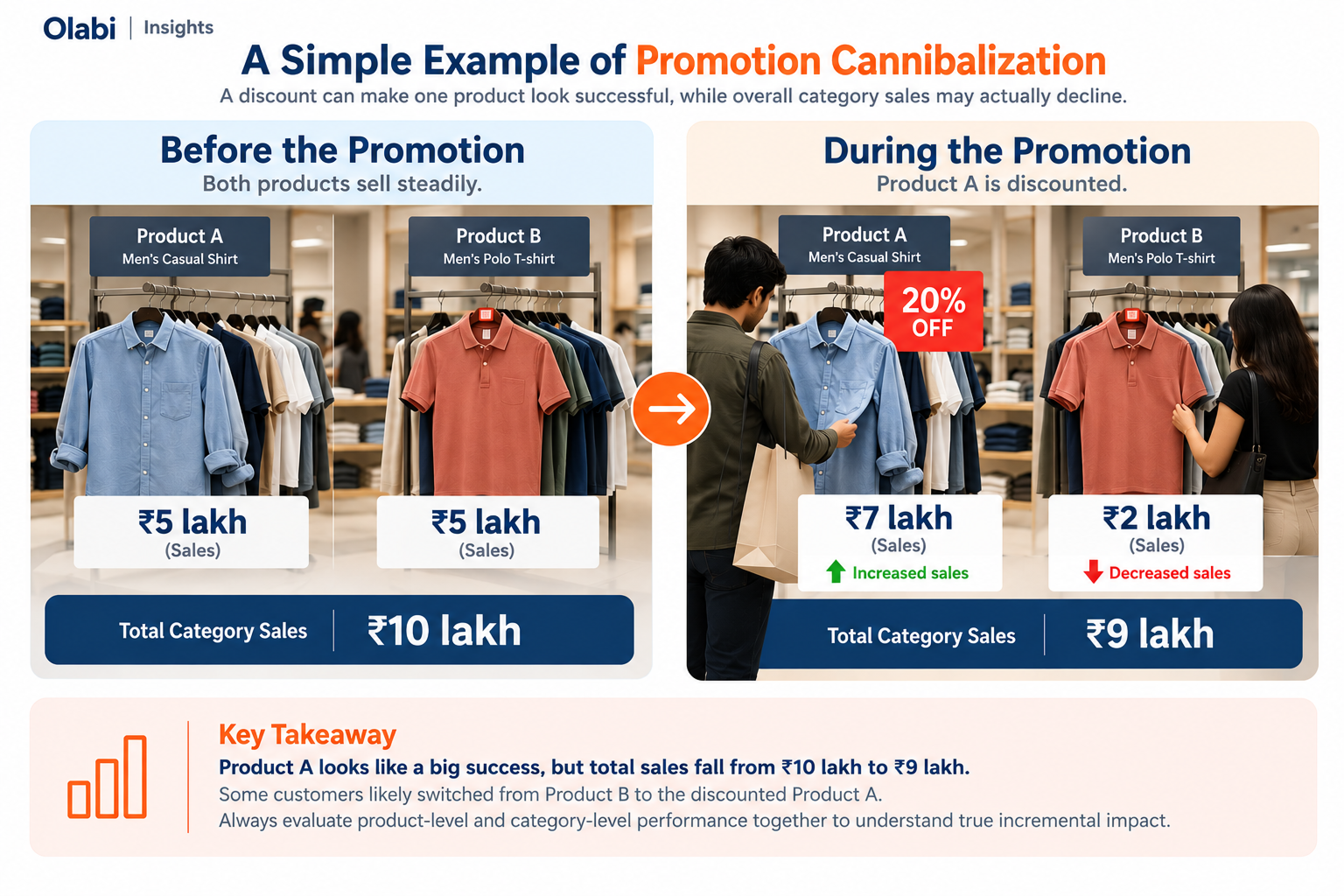
Consider a retailer selling two similar products, Product A and Product B.
Before the Promotion
Product A + Product B = ₹10 lakh
Now the retailer launches a discount on Product A.
During the Promotion
Product A = ₹7 lakh
Product B = ₹2 lakh
Total = ₹9 lakh
At first glance, Product A appears to have performed extremely well. Its sales increased significantly.
However, the bigger picture tells a different story.
The combined sales of both products actually declined from ₹10 lakh to ₹9 lakh.
Some customers who would previously have purchased Product B may have switched to the discounted Product A.
This is why looking only at the promoted SKU can be misleading. A retailer needs to evaluate product-level and category-level performance together to understand whether the promotion genuinely generated incremental sales or simply shifted existing demand.
How Retailers Can Reduce Promotion Cannibalization
Promotion cannibalization cannot always be eliminated, but retailers can reduce its impact by making promotions more targeted and data-driven.
Target Promotions More Precisely
Instead of offering the same discount to everyone, retailers can use customer behavior and purchase history to identify customers who are more likely to respond to a specific offer.
Avoid Discounting Highly Substitutable Products Together
Promoting similar products at the same time can encourage customers to switch between them rather than increase their overall spending. Retailers can carefully plan promotions across closely related SKUs and categories.
Use Customer and Purchase Data
Customer purchase patterns can help retailers understand which products customers typically consider as alternatives. This can help identify potential promotion cannibalization before a promotion is launched.
Consider Product Margins
A product that generates strong promotional sales but has a low margin may not create sufficient value. Retailers should consider both expected sales uplift and profitability when designing offers.
Plan Promotions Around Inventory and Demand
Promotions should align with inventory levels, product lifecycle, seasonality, and expected demand. This can help retailers use discounts to solve genuine inventory challenges rather than unnecessarily discounting products that would sell anyway.
Test Different Offers and Measure Incremental Impact
Retailers can experiment with different discount levels, products, customer segments, or stores and compare the results. Measuring incremental sales, margin, and cannibalization can reveal which promotional strategies create the most value.
Ultimately, the objective isn’t simply to create a sales spike. It is to design promotions that generate incremental demand while protecting profitability and minimizing unnecessary sales shifting.
Using Data to Make Promotions More Profitable
The effectiveness of a promotion depends on more than the discount offered. Retailers need to understand how customers, products, stores, and inventory respond to the promotion.
Connecting POS sales, inventory, customer, product, and promotion data gives retailers a more complete view of promotional performance.
For example, POS data can show how sales changed, while customer and product data can reveal whether customers switched from another SKU. Inventory data can show whether the promotion successfully moved excess stock, while margin data can indicate whether the additional sales were profitable.
Retailers can also compare promotional performance across stores, regions, categories, and customer segments. This can reveal why the same promotion may perform differently across locations and help identify where promotions are generating genuine incremental demand.
Historical data can provide another valuable layer. By comparing current campaigns with previous promotions, retailers can identify patterns in customer response, promotional lift, margin impact, and cannibalization.
Over time, these insights can help retailers move from simply running promotions to continuously improving how promotions are planned, targeted, and measured.
Conclusion
A successful promotion isn’t simply one that produces higher sales during the campaign.
Higher promotional sales don’t automatically mean higher business growth. Some of that increase may come from customers switching products, bringing purchases forward, moving between stores, or buying at a discount when they would have purchased anyway.
Understanding whether a promotion is creating genuine incremental demand or simply shifting existing demand allows retailers to make more informed promotional decisions.
Measuring promotion cannibalization alongside incremental sales, promotional lift, gross margin, and customer behavior can help retailers protect profitability and improve promotional ROI.
This requires connected data. When POS, inventory, customer, product, and retail analytics work together, retailers can get a clearer picture of what their promotions are actually achieving.
Make Every Promotion More Data-Driven With Olabi
Olabi brings POS, inventory, customer, and analytics data together on a connected retail platform, helping retailers gain better visibility into sales and inventory performance across stores and channels.
Want to understand which promotions are truly driving growth?
Schedule a demo with Olabi and discover how connected retail data can help you make smarter promotion and inventory decisions.
Share This Story, Choose Your Platform!
About the Author: Olabi

