
Olabi Sutras
The Digital-to-Store Journey: Turning Online Intent Into Store Purchases
For many shoppers today, the journey toward a purchase begins long before they enter a store. Customers search for products online, compare alternatives, read reviews, explore prices, and increasingly check whether a product is available at a nearby location.
Yet the final purchase may still happen in a physical store.
This means the customer’s decision to visit a store may already be influenced by everything they experienced online. A customer who discovers a pair of shoes through social media may research the product on a retailer’s website, check available sizes, find a nearby store, and then visit that store to try the product before purchasing it.
This connected path from online discovery and purchase intent to physical store interaction and purchase is what we can describe as the Digital-to-Store Journey.
For retailers, this journey creates an important opportunity. Instead of treating ecommerce and physical stores as separate channels, they can connect the two experiences and make it easier for customers to move between them. When online information, store inventory, customer insights, and in-store experiences work together, digital interest can translate into real-world store visits and purchases.
What Is the Digital-to-Store Journey?
The Digital-to-Store Journey describes the path a customer takes when online interactions influence their decision to visit a physical retail store and potentially make a purchase there.
Unlike a traditional store journey, where the customer’s interaction begins when they enter the store, the digital-to-store journey can start much earlier. A customer may first discover a product online, research it across multiple digital touchpoints, check its availability, and then decide to visit a store to experience or purchase it.
The journey can include several stages:
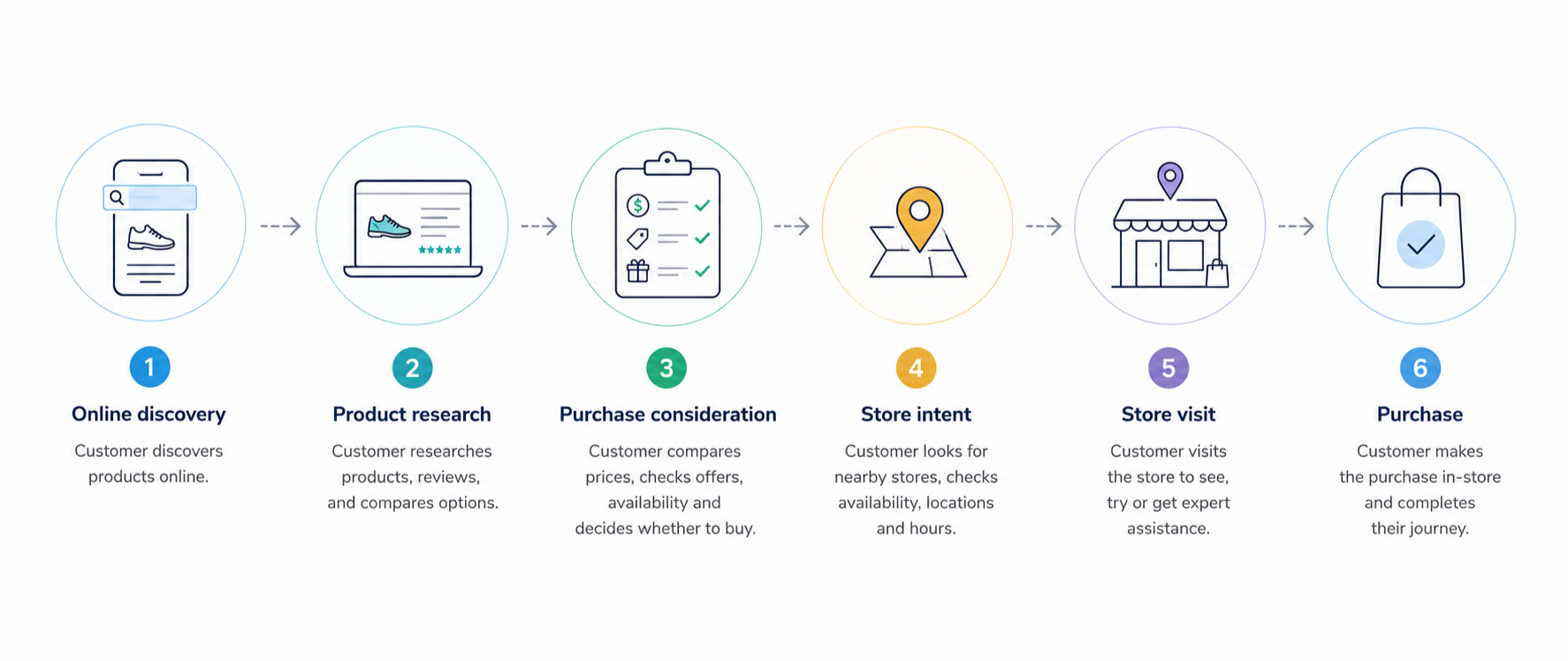
Online discovery → Product research → Purchase consideration → Store intent → Store visit → Purchase.
What makes this journey particularly important is that customers don’t necessarily think in terms of separate channels. They don’t see their interaction with a brand’s website, mobile experience, social media, and physical store as independent experiences. They simply see them as different touchpoints with the same brand.
This behavior is closely related to ROPO (Research Online, Purchase Offline), where customers use digital channels to research products before completing the transaction in a physical store. For example, a shopper might compare different products online, read customer reviews, check prices, and then visit a nearby store to see the product before making the final purchase.
For retailers, understanding this journey means recognizing that the physical store may no longer be the beginning of the customer relationship. It can be the next step in a journey that started digitally.
What Happens Before the Customer Walks Into the Store?
Before a customer enters a physical store, they may already have completed significant parts of their buying journey online. Every search, product view, review, comparison, and availability check can contribute to their decision to visit a particular store.
Understanding these digital behaviors helps retailers identify where online intent is being created and what ultimately motivates customers to move from the screen to the store.
Product Discovery
The journey often begins with discovery. Customers may encounter a product through:
- Search engines
- Social media
- Brand websites
- Online marketplaces
- Digital advertising
At this stage, the objective may simply be to discover something new. A social media post, search result, advertisement, or recommendation can introduce a customer to a product they had not previously considered.
Product Research
Once a product catches their attention, customers often move into research mode. They may look at:
- Product specifications
- Customer reviews
- Ratings
- Product comparisons
- Images and videos
This stage helps customers evaluate whether the product meets their needs. They may compare multiple products, investigate features, look at different variants, and seek reassurance from other customers before moving closer to a purchase decision.
Purchase Consideration
As interest becomes stronger, customers begin evaluating the practical aspects of purchasing the product.
They may check:
- Product price
- Current promotions
- Product availability
- Alternative products
- Nearby stores
At this point, the retailer’s digital experience can directly influence whether the customer decides to visit a physical location. Accurate product information, transparent pricing, and reliable availability can reduce uncertainty and make the store visit more purposeful.
Store Intent
The final stage before the physical visit is often the creation of store intent. A customer who has already decided that they want to experience or purchase a product may search for:
- A nearby store
- Store location
- Store operating hours
- Product availability at a specific location
- Click & Collect options
This is the critical transition from digital intent to physical action.
A customer who checks whether a particular size is available at a nearby store is no longer simply browsing. They are actively considering a store visit. If the information they receive is accurate and the product is available, the retailer has an opportunity to turn that digital intent into an in-store interaction and, ultimately, a purchase.
The key takeaway is simple: the store visit may be the final step of a decision that started online. Retailers that recognize and support this journey can create a much more connected experience between digital discovery and physical commerce.
The Moment Online Intent Becomes Store Intent
Not every customer who discovers a product online will eventually visit a physical store. The transition from digital browsing to an actual store visit happens when the customer has a clear reason to continue the journey offline.
One of the biggest reasons is the desire to see the product physically. Customers may want to assess the material, quality, fit, color, or overall appearance before making a purchase. This is particularly important for categories such as fashion, footwear, beauty, furniture, and electronics, where physical interaction can influence the final decision.
The need to try a product before buying can be an equally strong motivator. A customer may research a pair of shoes online but still want to visit a store to check the fit. Similarly, shoppers may want to test an electronic device, experience a fragrance, or try on apparel before committing to the purchase.
Immediate availability can also turn online interest into store intent. When customers can see that a product is available at a nearby store, they have a stronger reason to visit rather than wait for delivery. Accurate store-level inventory therefore becomes an important part of connecting digital demand with physical commerce.
For some categories, the product experience itself is a reason to visit. Physical stores allow customers to touch, test, compare, and experience products in ways that digital channels cannot completely replicate.
There is also an element of trust in the physical store. Customers may feel more comfortable making certain purchases after speaking with a knowledgeable associate or seeing the product in person.
Personal assistance can further influence the decision. Customers may visit a store because they want expert recommendations, help choosing between products, or guidance on size, fit, features, or usage.
The ability to make a same-day purchase can also be a strong driver. When a customer needs a product immediately, visiting a nearby store can be more attractive than waiting for online delivery.
Finally, in-store promotions and exclusive offers can encourage customers to complete their journey offline, particularly when the offer provides a clear reason to visit a physical location.
However, online intent does not automatically become store traffic. Retailers need to remove uncertainty and friction at every stage between digital discovery and physical visitation. Accurate inventory, reliable store information, consistent pricing, and a connected customer experience can make the difference between a customer simply browsing online and actually walking into a store.
What Can Break the Digital-to-Store Journey?
A customer can have strong purchase intent and still abandon the journey if the online and physical experiences don’t match. Even small inconsistencies can create uncertainty, reduce trust, and ultimately prevent a store visit or purchase.
One of the most frustrating situations is when a website shows a product as available, but the store doesn’t actually have it. A customer may make the effort to visit the location only to discover that the product, size, or color they wanted is unavailable.
This problem becomes even more significant when customers cannot see store-level inventory. Without reliable availability information, they have no way of knowing whether a particular location is worth visiting.
Inconsistent pricing between online and offline channels can also create friction. If a customer researches a product online at one price and encounters a different price in the store without clear communication, it can damage trust and make the purchase decision more difficult.
Basic information can create friction too. Outdated store locations, incorrect operating hours, or inaccurate information about store services can turn an intended visit into a wasted trip.
Another missed opportunity is the inability to reserve a product before visiting. Customers who know exactly what they want may be reluctant to travel to a store without confidence that the product will still be available when they arrive.
The experience can also break when online product information doesn’t match the physical product. Differences in descriptions, specifications, images, pricing, or available variants can create confusion at the point of purchase.
Even when the product itself is available, the expected size, color, or variant may be missing. This is particularly damaging when the customer has already made the decision to visit based on information provided online.
Finally, the connection can break inside the store itself. If store associates have no visibility into relevant customer interactions or online activity, the customer may feel as though they are starting the journey all over again. A shopper who has already researched a product online should not necessarily have to repeat the entire process once they enter the store.
These gaps highlight an important reality: a digital-to-store journey is only as strong as its weakest connection. Retailers need to ensure that information, inventory, pricing, and customer context remain consistent as shoppers move from digital channels into physical stores.
Turning Digital Intent Into a Successful Store Visit
Once a customer has shown clear online intent, retailers have an opportunity to make the transition to the physical store as seamless as possible. The goal is to remove uncertainty, provide useful information, and give customers a clear reason to continue their journey offline.
Make Store Inventory Visible
Customers should be able to see whether the product they are interested in is available at a nearby store. Providing accurate, store-level inventory information gives customers confidence that their visit is worthwhile.
Real-time availability is particularly important for high-intent shoppers who are looking for a specific product, size, color, or variant.
Enable Product Reservation
Allowing customers to reserve products before visiting can remove one of the biggest sources of uncertainty. Instead of simply telling customers that a product is available, retailers can give them the option to hold it for collection or in-store purchase.
This creates a stronger connection between online intent and physical store traffic.
Provide Accurate Store Information
Basic information should be reliable and easy to access. Store location, operating hours, contact details, available services, and product availability should remain consistent across digital touchpoints.
When customers can confidently plan their visit, retailers reduce unnecessary friction and improve the likelihood of conversion.
Connect Online and Offline Promotions
Customers shouldn’t encounter confusing differences between digital and physical promotions. Where offers differ by channel, retailers should communicate those differences clearly.
Connecting promotions across channels can also give customers an additional reason to visit a store, whether through exclusive in-store offers, personalized promotions, or incentives linked to their online activity.
Enable Store Associates With Customer Context
The transition shouldn’t stop when the customer enters the store. Associates can play an important role in continuing the journey by having access to relevant customer information, product interactions, purchase history, preferences, or online activity where appropriate.
This allows associates to provide more relevant recommendations instead of treating every visitor as a first-time customer.
When inventory, store information, promotions, and customer context are connected, retailers can turn online interest into a more purposeful store visit and ultimately create a smoother path from digital intent to physical purchase.
The Store Visit: Where Digital Intent Becomes Revenue
The store visit is where the digital research and purchase intent built online can finally translate into a physical purchase. By the time a customer walks through the door, they may already know the product they want, its price, preferred size or color, and even the store they want to visit.
Retailers therefore shouldn’t treat the customer as if their journey is starting from zero.
Product availability is the first priority. If the customer has already searched for a particular product online, ensuring that it is available when they arrive can significantly improve the likelihood of conversion.
From there, personalized recommendations and associate assistance can help customers make more confident decisions. Associates can use the customer’s existing intent as a starting point rather than repeating the discovery process.
For products where physical experience matters, product demonstrations can further strengthen the purchase decision. Once the customer is engaged, relevant cross-selling and upselling opportunities can increase basket size without making the interaction feel disconnected from the customer’s original intent.
Loyalty recognition can make the experience even more personalized by allowing retailers to recognize returning customers and provide relevant offers or recommendations based on their relationship with the brand.
The final step is reducing friction at checkout. Faster checkout experiences help customers complete purchases without unnecessary delays, while capabilities such as an Endless Aisle allow associates to help customers purchase products that aren’t physically available in the store by accessing inventory across the wider retail network.
The objective is to make the physical store feel like a continuation of the customer’s digital journey, not a completely separate experience.
Measuring the Digital-to-Store Journey
Understanding the digital-to-store journey requires retailers to look beyond traditional store KPIs. Instead of measuring only what happens after a customer enters the store, retailers need to connect the signals that show how digital interest develops into store intent and eventually into a purchase.
Digital Intent
The journey begins with signals that indicate customer interest.
Retailers can monitor:
- Product searches
- Product page views
- Store locator searches
- Store availability checks
These signals help identify which products are generating interest and when customers begin considering a physical store.
Store Intent
The next stage is determining whether digital interest is translating into an intention to visit or purchase from a store.
Relevant indicators include:
- Store visits following digital interactions
- Product reservations
- Click & Collect orders
- Store-specific product searches
These metrics help retailers understand whether their digital experience is successfully influencing physical store activity.
Store Conversion
Once the customer enters the store, retailers can measure:
- Digital-to-store conversion
- Store conversion rate
- Average Order Value
- Cross-sell rate
Comparing these metrics with digital intent signals can help retailers understand how effectively they are converting online interest into physical purchases.
Customer Outcome
The journey doesn’t end at the first purchase. Retailers should also evaluate longer-term outcomes such as:
- Repeat purchases
- Loyalty engagement
- Customer lifetime value
- Customer satisfaction
Connecting these stages provides a clearer picture of the entire journey, from digital discovery to store visit to purchase and continued customer engagement.
Connecting Online Intent With Store-Level Inventory
A customer can have strong purchase intent, but that intent means little if the product isn’t available when and where they want it.
This makes inventory visibility one of the most important connections between digital and physical retail. When a customer searches for a product online, retailers need to connect that demand with the inventory available across their store network.
The journey can be viewed simply as:
Customer demand → Product → Store → Inventory → Purchase
With real-time store inventory, customers and associates can see whether a particular product, size, or variant is actually available at a specific location.
A Single Pool Inventory approach can take this further by allowing retailers to view inventory across stores and fulfillment locations as one connected pool rather than treating each location as an isolated inventory bucket.
Endless Aisle capabilities can also help when the product isn’t physically available in the customer’s current store. Associates can access inventory from other locations and complete the transaction rather than losing the sale.
This becomes even more powerful when combined with cross-store inventory visibility and order fulfillment. Instead of telling a customer that a product is unavailable simply because their local store doesn’t have it, retailers can identify inventory elsewhere and provide an alternative path to purchase.
Ultimately, connecting online intent with store-level inventory allows retailers to turn digital product interest into physical-store opportunities. The customer gets a more reliable and convenient experience, while retailers make better use of inventory across their entire network.
From Digital-to-Store to Unified Commerce
Getting customers from a website to a physical store is only one part of the opportunity. The larger goal is to create a connected commerce journey where customers can move between digital and physical touchpoints without feeling like they are switching channels.
In a truly connected experience, online discovery can inform the store interaction. A customer who has already researched a product online should be able to continue that journey with relevant product information and assistance when they visit the store.
At the same time, store inventory can support digital demand. Products available in physical locations can become part of the broader inventory pool available to online customers, creating more opportunities to fulfill demand.
The role of the store associate also changes. With access to relevant customer context, associates can understand what the customer may already know, what they are looking for, and how they can add value to the interaction.
Customers should also be able to move between channels effortlessly. They might discover a product online, check availability at a store, visit the store to try it, purchase it through an associate, and later engage with the brand through another digital channel. The experience should remain connected throughout.
This is where unified commerce goes a step further than traditional omnichannel retail. Omnichannel focuses on connecting customer experiences across channels, while unified commerce aims to bring the underlying customer, product, inventory, order, and transaction data together on a common platform.
The objective is no longer simply to connect channels. It is to make the entire retail business operate as one connected commerce ecosystem.
Conclusion
The modern customer journey rarely follows a single channel. A customer may discover a product online, research it across multiple digital touchpoints, check store availability, and then visit a physical store to complete the purchase.
For retailers, this creates an opportunity to turn digital intent into physical-store revenue. But doing so requires more than simply driving online traffic to stores. The information customers see online must match what they experience in the physical world.
Accurate inventory visibility, connected customer data, reliable store information, and empowered store associates all play an important role in removing friction from this journey.
The goal is not simply to increase store visits. It is to create a seamless journey where digital discovery, store interaction, and purchase work together.
With capabilities such as real-time inventory visibility, POS integration, Endless Aisle, Single Pool Inventory, omnichannel fulfillment, customer insights, and connected store operations, Olabi helps retailers bridge the gap between digital commerce and physical retail.
Want to turn online customer intent into in-store purchases?
Schedule a demo with Olabi to discover how connected inventory, POS, and omnichannel capabilities can help you create a more seamless journey from digital discovery to physical store experience.
Share This Story, Choose Your Platform!
About the Author: Olabi

