
Olabi Sutras
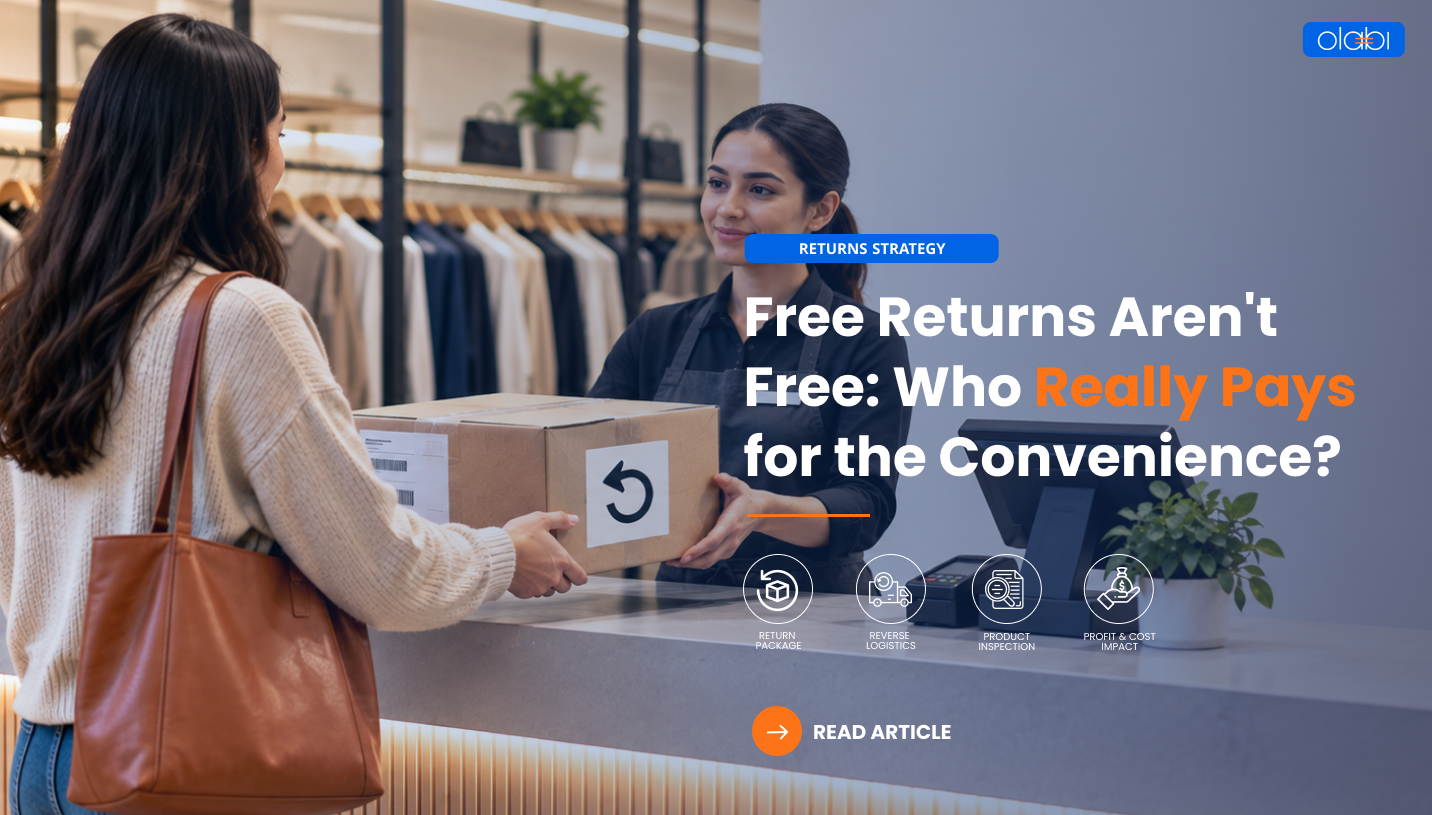
Free Returns Aren’t Free: Who Really Pays for the Convenience
For customers, returning a product is simple. They order something, decide it isn’t right, and send it back without paying an additional fee. The experience feels convenient and risk-free.
For retailers, however, the process is far more complicated.
A returned product may need to be collected, transported, inspected, repackaged, processed, and returned to sale. Some products can be resold immediately, while others may require markdowns or become unsellable altogether. Every step adds cost.
Yet free returns have become an important part of the shopping experience. Customers increasingly expect a straightforward returns policy, and making returns difficult can discourage purchases in the first place.
This creates a commercial dilemma: how can retailers make returns convenient for customers without allowing the cost of that convenience to undermine profitability?
To understand the answer, we need to look beyond the return label and examine what happens after a product leaves the customer’s hands.
What Does a Free Return Actually Cost a Retailer?
A return is not a single transaction. It is a chain of activities, each with its own operational cost.
Consider an apparel customer who orders three shirts, keeps one, and returns the other two because the fit isn’t right.
The retailer may incur costs across several stages:
- Reverse shipping: Transporting the returned products from the customer to a warehouse, store, or processing centre.
- Inspection and quality checks: Checking for damage, wear, missing tags, or signs of use.
- Processing and repackaging: Updating records, preparing the products for resale, and restoring their packaging.
- Handling and storage: Moving returned goods through facilities and holding them until they can be sold again.
- Value loss: Discounting products that have lost their original selling opportunity or are no longer suitable for full-price sale.
There may also be customer service costs, payment processing implications, and additional administrative work.
Not every return incurs every cost, and the actual amount varies by product category, retailer, fulfilment model, and reason for return. Nevertheless, the cumulative expense can be significant.
The important distinction is that the customer may pay nothing for a return, but the retailer still has to absorb the operational cost somewhere in its business model.
Who Really Pays for Free Returns?
The answer isn’t always straightforward. The retailer may initially bear the expense, but its commercial impact can spread across several parts of the business.
The retailer absorbs the cost
Retailers can treat return expenses as part of customer acquisition and service costs. This may make sense when a convenient returns policy encourages more purchases, improves conversion, or builds long-term loyalty.
However, the economics depend on whether the additional business generates enough contribution to cover the costs.
The customer may pay indirectly
A retailer may incorporate the cost of returns into its overall pricing strategy. That doesn’t mean every product price increases because of returns, but the economics of servicing returns can influence pricing, promotional budgets, and margins.
Customers who rarely return products may also be participating in a business model that supports the convenience used by frequent returners.
The business absorbs the impact through lower margins
Even without changing prices, returns can reduce the profit earned on sales. Additional handling expenses, markdowns, and unsellable products can erode the contribution a retailer expected to earn.
Suppliers and other partners may share some costs
Depending on commercial agreements, product defects, fulfilment arrangements, and return policies, certain expenses may be shared with suppliers or logistics partners.
Ultimately, the cost allocation depends on the retailer’s business model and contractual arrangements. There is no single party that always pays.
Why Free Returns Can Increase Sales and Still Hurt Profitability
Free returns can remove a major barrier to online shopping.
A customer uncertain about a shirt’s fit may be more willing to order it if returning it is easy. A shopper comparing two sizes may purchase both, planning to keep one. A customer buying an unfamiliar brand may feel more comfortable trying it for the first time.
These behaviours can increase order conversion and encourage product discovery.
But there is an important distinction between generating more orders and generating more profitable orders.
Imagine two hypothetical retailers:
- Retailer A generates ₹10 lakh in sales with relatively low return-related costs.
- Retailer B generates ₹12 lakh in sales, but a larger share of those orders is returned, creating higher logistics, handling, and markdown expenses.
Retailer B has higher reported sales before considering the full impact of returns. That alone doesn’t tell us which retailer earns more profit.
A meaningful comparison must account for retained sales, product margins, reverse logistics, processing costs, and any loss in product value.
Free returns can be a valuable customer acquisition strategy. They become a problem when retailers measure the revenue they generate without measuring the cost of fulfilling the promise.
The Hidden Problem: Not Every Returned Product Can Be Sold Again at Full Price
The financial impact of a return depends heavily on what happens to the product afterward.
Consider three possible outcomes.
Scenario A: The product returns in perfect condition.
It passes inspection, is repackaged, and returns to sale. The retailer incurs handling and logistics expenses, but much of the product’s commercial value is preserved.
Scenario B: The product misses its original selling opportunity.
A seasonal garment arrives back after demand has declined. The product may still be sellable, but the retailer might need to discount it to clear the remaining stock.
Scenario C: The product cannot be resold.
Damage, hygiene considerations, missing components, or product-specific restrictions may prevent the item from returning to normal sale.
The consequences differ by category. Apparel, footwear, electronics, beauty products, and perishable goods all have different inspection and resale requirements.
This is why measuring only the number of returned products provides an incomplete picture. Retailers also need to understand the condition of returned goods, the time taken to process them, and their eventual resale outcome.
Why Some Products Are Returned More Often Than Others
Return behaviour is not random. It can reveal problems in the shopping experience.
For apparel, customers may return products because sizing is inconsistent or product photographs don’t accurately communicate fit. For electronics, the product may not meet the customer’s expectations or may be incompatible with their existing setup. For home products, dimensions, colour differences, or assembly requirements may influence the decision.
Retailers can examine patterns across product categories, individual SKUs, sizes, suppliers, sales channels, and return reasons.
For example, if a particular shirt repeatedly receives returns because it fits smaller than expected, simply processing those returns more efficiently won’t solve the underlying issue.
The retailer could improve size guidance, revise product descriptions, update imagery, or investigate manufacturing consistency.
The objective is not merely to handle returns better. It is to prevent avoidable returns without making legitimate returns difficult for customers.
The Difference Between a Customer-Friendly Returns Policy and an Unprofitable One
A strict returns policy may reduce certain costs, but it can also create friction, damage customer trust, and discourage future purchases.
At the other extreme, an overly generous policy may encourage unnecessary ordering, increase reverse logistics, or expose the business to misuse.
Retailers therefore need to evaluate returns as part of the complete customer experience rather than treating them as an isolated cost centre.
A practical approach includes:
- Making product information accurate and easy to understand.
- Providing useful sizing guides, specifications, and product demonstrations.
- Offering convenient returns while maintaining clear and fair conditions.
- Identifying recurring product-quality or fulfilment issues.
- Evaluating return costs alongside conversion, retention, and customer satisfaction.
- Reviewing policies based on category economics rather than applying assumptions uniformly.
The right policy is not necessarily the strictest or the most generous. It is one that protects customer confidence while remaining commercially sustainable.
The Metrics Retailers Should Track Beyond Return Rate
Return rate is useful, but it cannot explain the entire financial impact.
Retailers should consider a broader set of measures:
Return rate: The proportion of orders or units returned, with the calculation clearly defined.
Return cost per order: The average cost associated with handling returns for an order.
Recovery value: The value recovered when returned products are resold, including any markdown required.
Time to restock: How long a returned product takes to become available for sale again.
Return reason distribution: The share of returns attributable to sizing, product expectations, defects, fulfilment errors, or other causes.
Net contribution after returns: The contribution remaining after relevant product costs, discounts, return-related expenses, and value losses are considered.
These measures become more useful when compared by product category, channel, location, and time period. They help retailers distinguish between a category with naturally higher return rates and one where returns indicate a preventable business problem.
How Connected Retail Data Can Help Reduce the Cost of Returns
Returns involve more than the reverse logistics team. They can reveal issues in product information, sales, fulfilment, quality, and customer expectations.
When those functions operate in isolation, a retailer may know how many products were returned without understanding why the returns occurred or what they cost the business.
Connecting sales, product, inventory, and customer information can help retailers identify recurring patterns and make more informed decisions.
For example, a retailer may discover that a particular product has an unusually high return rate across multiple locations. Further analysis might reveal inconsistent sizing, inaccurate product information, or a recurring quality concern.
The retailer can then address the underlying issue instead of repeatedly processing the same avoidable returns.
Connected retail systems can also help maintain clearer visibility into transactions and product movements across stores and channels. The precise capabilities depend on how the retailer’s systems are integrated and how return workflows are designed.
For retailers, the objective is to move from processing returns as individual transactions to understanding them as a source of operational and commercial insight.
Conclusion
Free returns are neither inherently good nor inherently bad for retail businesses. They are a commercial decision with consequences for customer confidence, conversion, operating costs, and profitability.
The real challenge is understanding the complete economics behind the promise.
Retailers need to know why products are returned, what happens to them afterward, how much value is recovered, and whether their returns policy supports sustainable customer relationships.
Technology can help connect the information needed to make those decisions. Olabi helps retailers bring together sales, inventory, and retail operations through a connected platform, supporting better visibility across day-to-day business activities.
Want to make more informed retail decisions with connected business data? Schedule a demo with Olabi to explore how a unified retail platform can support your operations.
Share This Story, Choose Your Platform!
About the Author: Olabi

