
Olabi Sutras
The End of the Traditional Shopping Journey? How Gen Z Shopping Is Changing Retail
For decades, shopping followed a relatively predictable path: discover a product, visit a store or website, compare options, and make a purchase. The journey was largely controlled by the retailer, with brands deciding where customers discovered products, how they interacted with them, and where transactions happened.
That journey has become far more fragmented.
For Gen Z, shopping journey can begin anywhere. A product might first appear in an Instagram Reel, a creator’s recommendation, or a short-form video. The consumer may then search for reviews on Google or YouTube, compare prices on marketplaces, visit the brand’s website, check social media comments, and eventually walk into a physical store before making a purchase.
The important shift is that these aren’t separate shopping channels anymore, they are interconnected touchpoints within one journey.
A Gen Z customer might:
Discover → Search → Watch Reviews → Compare → Visit Store → Purchase → Share
And the journey doesn’t necessarily end after the transaction. A purchase can lead to a social post, review, recommendation to friends, or another discovery for someone else.
This creates a fundamental change for retailers. The customer is no longer moving through a journey designed by the retailer. The customer is creating their own journey.
For retailers, the challenge is therefore no longer simply being present across online and offline channels. It is about ensuring that every interaction feels connected, consistent and relevant, regardless of where the journey begins or ends.
From Search to Social: Where Gen Z Discovers Products
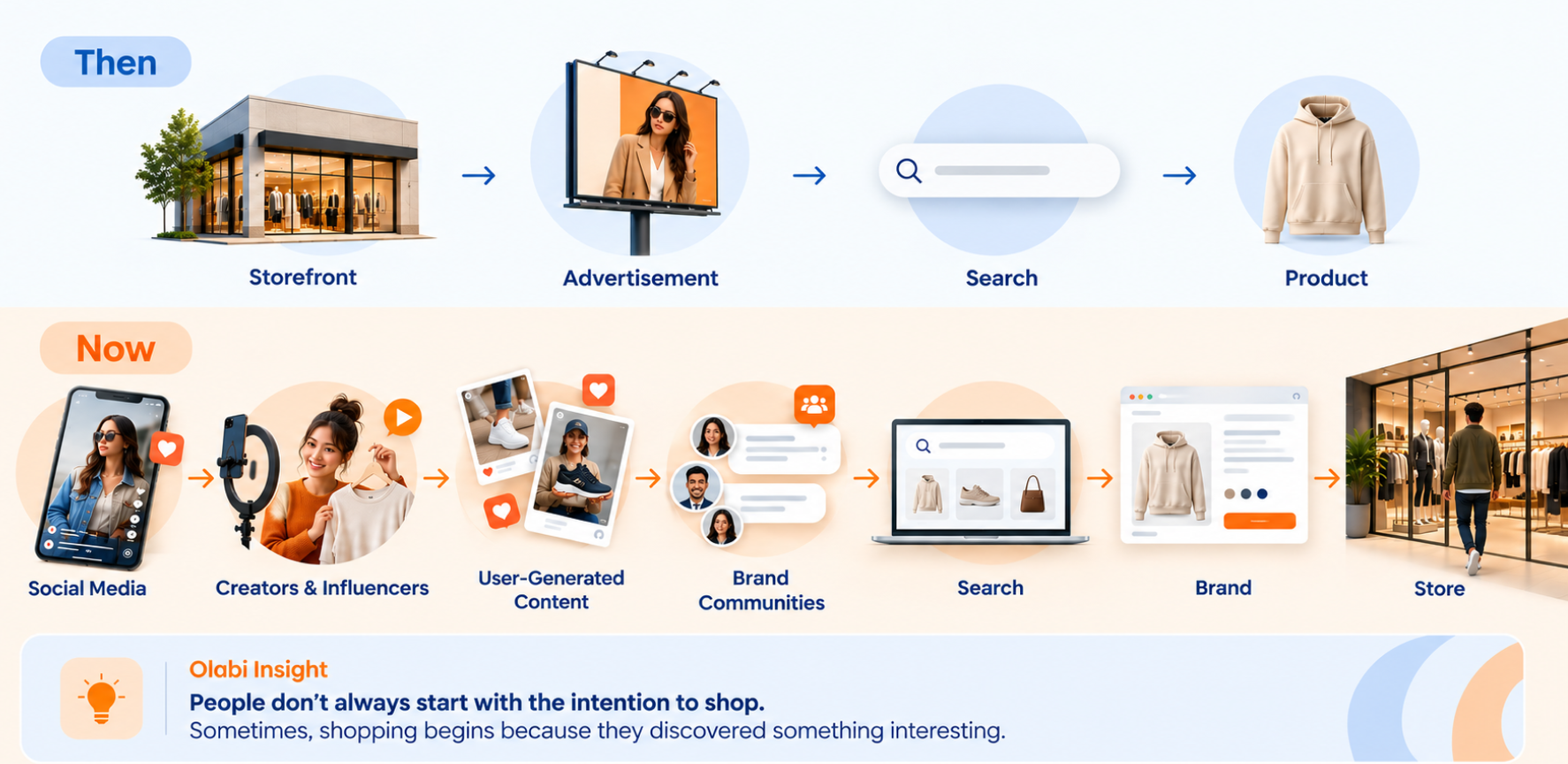
Product discovery has traditionally been driven by storefronts, advertisements, search engines and brand websites. A consumer who wanted a product would actively search for it, visit a store, or encounter it through traditional advertising.
Gen Z has changed the starting point.
Instead of always searching for a product, they can discover it while consuming content.
A fashion product can appear in a creator’s outfit video. A new sneaker can gain attention through a short-form review. A skincare product can become popular through user-generated content. A brand can become desirable because consumers see it repeatedly within a particular online community.
This makes social platforms increasingly important not just as marketing channels, but as product discovery environments.
The new discovery ecosystem
Social Media
Products appear naturally within the content consumers already consume.
Creators & Influencers
Recommendations can introduce products through personal experiences rather than traditional advertising.
Short-Form Video
Products can be demonstrated, reviewed and styled within seconds, making discovery highly visual and immediate.
User-Generated Content
Real customers provide social proof through reviews, try-ons, unboxing videos and everyday product usage.
Brand Communities
Consumers discover products through conversations, trends and communities built around shared interests.
The result is a significant change in consumer behaviour: people don’t always start with the intention to shop. Sometimes, shopping begins because they discovered something interesting.
A consumer scrolling through social media may have no intention of buying a pair of sneakers. A few minutes later, a creator’s video can trigger curiosity. That curiosity leads to a Google search, then reviews, then the brand’s website, and eventually a purchase.
This is why the traditional distinction between marketing and shopping is becoming increasingly blurred.
From “I want something, so I’ll search for it” to “I discovered something, and now I want it.”
For retailers, this means being discoverable is no longer limited to search rankings, storefront visibility or advertising. Brands need to think about how their products appear within the content, communities and conversations that consumers already engage with.
Discovery is becoming less about actively finding a product and more about encountering the right product at the right moment.
The Gen Z Shopping Journey Is No Longer Linear
The traditional shopping journey followed a fairly predictable path: discover a product, research it, compare alternatives, and purchase. Retailers could broadly understand where customers entered the journey and how they moved toward a transaction.
Gen Z has made that journey much less predictable.
They move between different sources of information depending on what they need at each stage. A product discovered through social media may lead to independent research, reviews, price comparisons, a store visit, and eventually a purchase. The same customer might also return to social media after the purchase to share their experience.
The important change isn’t simply that there are more channels. It is that consumers no longer experience those channels as separate stages.
The journey can move forward, pause, restart or change direction entirely.
This means retailers need to move away from thinking about the customer journey as a funnel and start thinking about it as a connected ecosystem of touchpoints.
Traditional vs. Gen Z Shopping Journey
Traditional
Awareness → Consideration → Purchase
Gen Z
A multi-directional journey where discovery, research, comparison, physical experience and purchase can happen in different combinations.
The retailer’s role is no longer to guide every customer through the same path. It is to make sure that wherever the customer enters, the next step is easy.
Online and Offline Are No Longer Separate
For Gen Z, the distinction between online and offline shopping is becoming less meaningful.
A customer may research a product online before visiting a store, use their phone while inside the store, or discover something physically and complete the purchase later online.
What matters is not where the interaction happens, but whether the experience remains connected.
This creates new expectations around:
- Consistent product information across channels
- Real-time visibility into product availability
- Flexible purchase and fulfillment options
- Easy returns and exchanges
- Personalized assistance
- The ability to move between digital and physical experiences without friction
For retailers, this changes the role of omnichannel from simply offering multiple sales channels to connecting the entire customer experience.
A customer shouldn’t feel like they are dealing with a different brand simply because they moved from the website to the store.
The Changing Role of the Physical Store
The rise of digital shopping hasn’t made the physical store irrelevant. Instead, it has changed what customers expect from it.
Traditionally, the store was primarily a place to browse products, interact with a salesperson and complete a transaction.
Today, especially for younger consumers, the store can serve several purposes: discovery, experience, validation, personalization and fulfillment.
Customers can walk into a store to experience a product before buying it online. They can seek recommendations from store associates, access products that aren’t physically displayed, or use the store as part of a larger omnichannel journey.
Technology is making this possible.
Solutions such as Endless Aisle, mobile POS, clienteling and omnichannel fulfillment allow retailers to extend the capabilities of a physical store beyond its four walls.
For example, when a preferred size or product isn’t available in a particular store, the customer doesn’t necessarily have to leave empty-handed. Store associates can help access the wider assortment and complete the purchase through another fulfillment option.
The result is a shift from:
Store as a transaction point to Store as an experience, engagement and fulfillment hub.
The physical store isn’t competing with digital anymore. It is becoming part of a much larger connected retail experience.
What Actually Influences Gen Z’s Purchase Decisions?
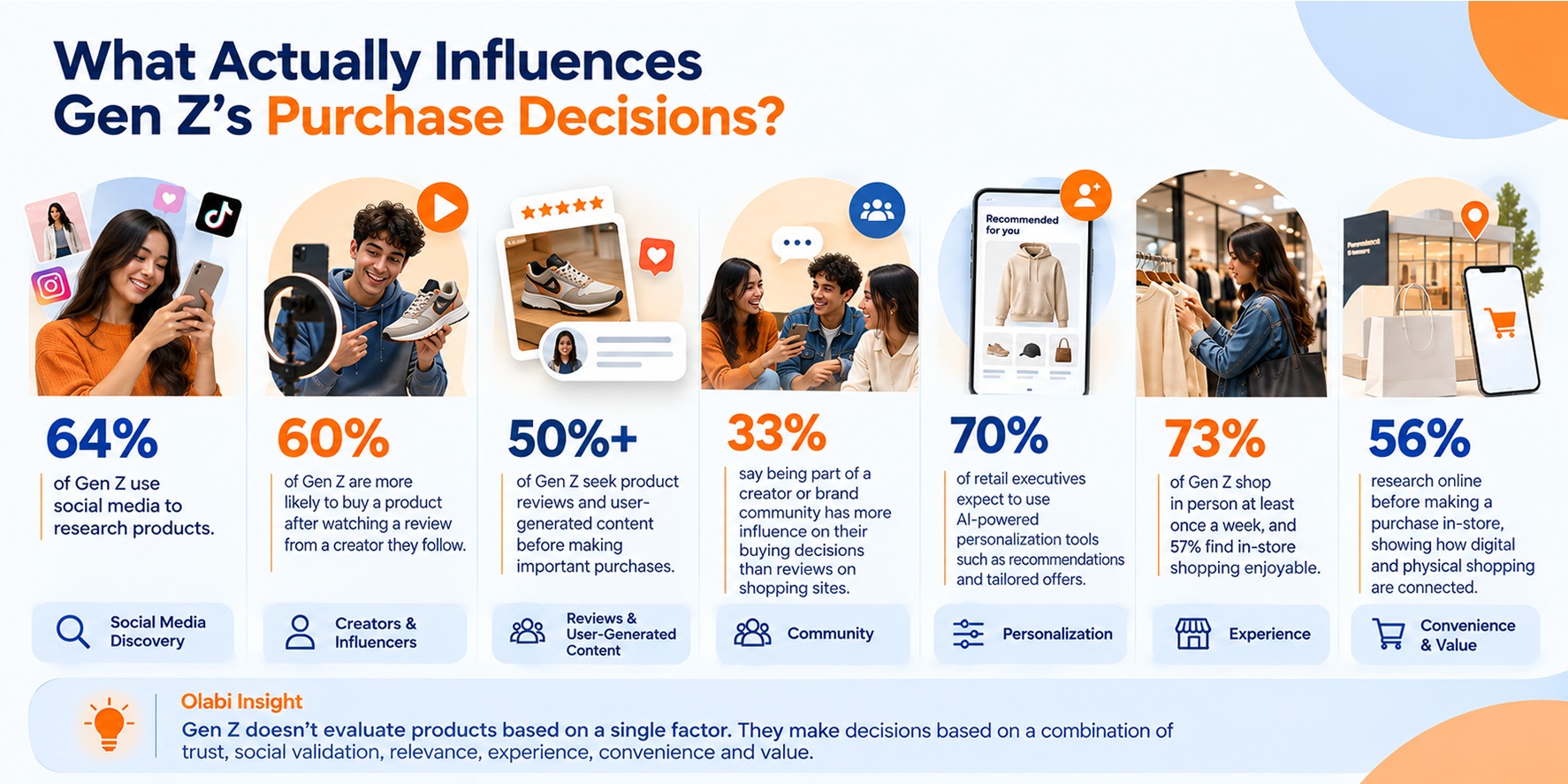
Gen Z’s purchase decisions are influenced by more than traditional advertising or price. Trust, social validation, relevance, experience and convenience increasingly shape how they discover and evaluate products.
The numbers show just how much this behaviour is changing.
According to Deloitte’s 2025 retail research, 64% of Gen Z consumers use social media to research products, while 35% use it specifically to discover products, almost twice the rate of older generations. At the same time, Gen Z hasn’t abandoned physical retail: 73% shop in person at least once a week.
This points to an important shift: Gen Z isn’t replacing physical shopping with digital shopping. They’re combining the two.
Creators and Influencers
Creators have become an important part of the discovery and consideration process.
Deloitte found that around 60% of Gen Z and Millennials are more likely to buy a product after watching a review from a content creator they follow, while nearly 70% of Gen Z respondents said creator product reviews feel more authentic than brand advertisements.
This changes the role of creators. They aren’t simply another advertising channel. They can act as a discovery, validation and recommendation layer between a consumer and a brand.
In fashion, beauty and lifestyle especially, a creator demonstrating how a product looks, fits or works can make an unfamiliar product immediately relevant.
Reviews and User-Generated Content
Before purchasing, consumers increasingly look beyond what the brand says about its product.
They want to know:
- How real customers use it
- What the product actually looks like
- Whether it delivers on its promises
- What other buyers think about it
This makes reviews, ratings, try-ons, unboxing videos and user-generated content important sources of validation.
Deloitte’s research also found that more than 50% of Gen Z and Millennials seek product reviews from creators when making important purchasing decisions.
The implication is significant: the brand is no longer the only voice shaping the perception of its product.
Community
Gen Z’s relationship with brands can extend beyond the product itself.
Communities built around interests, lifestyles, creators or cultural trends can influence what consumers discover and consider.
Deloitte found that almost one-third of consumers say being part of a creator or brand community has more influence on their buying decisions than reviews on shopping sites.
That makes community more than a social engagement strategy. It can become part of the purchase decision itself.
Personalization
Gen Z increasingly expects brands to make shopping more relevant to their individual preferences.
This could include:
- Relevant product recommendations
- Personalized offers
- Tailored communication
- Loyalty experiences
- Recommendations based on previous interactions
The broader retail industry is responding to this shift. Deloitte’s 2025 retail outlook found that seven in ten retail executives expect retailers to increasingly use AI-powered tools such as recommendations and price comparisons.
The challenge is getting the balance right. Personalization should make shopping easier and more relevant, not feel intrusive.
Experience
One interesting misconception is that Gen Z’s digital behaviour means they don’t value physical stores.
The data suggests otherwise.
73% of Gen Z consumers shop in person at least once a week, according to Deloitte’s 2025 retail research. 57% of Gen Z respondents also described in-person shopping as enjoyable, compared with 35% of Baby Boomers.
This suggests that physical retail still has an important role, but the reason for visiting a store can be different.
The store can become a place to experience, try, discover and interact with products, rather than simply complete a transaction.
Convenience and Value
Despite the importance of discovery and experience, convenience remains fundamental.
Gen Z expects flexibility around how they discover, purchase, receive and return products.
Interestingly, Deloitte found that 56% of consumers research online before making a purchase in-store, demonstrating that digital and physical shopping are already deeply connected.
In India, the shift is particularly significant. A 2025 Deloitte–FICCI report estimated that Gen Z would account for 43% of India’s total consumption in 2025, with approximately US$250 billion in direct spending power.
More recent Google–Deloitte research projects that India’s Gen Z cohort will account for 45% of online spending by 2030, reinforcing the importance of digital-led discovery and personalized commerce.
The Bigger Shift
The numbers point to something bigger than simply “Gen Z likes social media.”
They show a consumer who:
Discovers digitally → Validates socially → Experiences physically → Purchases wherever convenient
And this is where the traditional shopping funnel starts to break down.
Gen Z isn’t choosing between online and offline. They’re using both to make better purchase decisions.
For retailers, the opportunity isn’t simply to invest more in social media or open more stores. It is to connect the entire journey, from discovery and social proof to physical experience, purchase and post-purchase engagement.
What This Means for Retailers
The changing consumer journey requires retailers to rethink how they build and operate their businesses.
The biggest shift is moving from managing individual channels to designing a connected customer experience.
From Channels → Connected Experiences
Having a website, app, social presence and physical stores is no longer enough.
These touchpoints need to work together. Customers should be able to move between them without losing product information, context or convenience.
From Transactions → Experiences
The role of retail is expanding beyond simply completing a sale.
Stores, websites and digital platforms need to help customers discover, explore, experience and engage with the brand, not just purchase from it.
From Store Inventory → Connected Inventory
A customer’s shopping experience shouldn’t be restricted by what happens to be available in one location.
Connected inventory and Endless Aisle capabilities can allow retailers to give customers access to a broader assortment and provide more flexible fulfillment options.
From Salespeople → Digital Retail Advisors
The modern store associate can be more than someone who helps a customer find a product.
With access to customer information, product details, inventory visibility and mobile tools, store teams can provide more informed and personalized assistance.
From Customer Data → Customer Understanding
Collecting customer data is only the beginning.
Retailers need to connect and use that information to understand preferences, behaviour and interactions across touchpoints and turn those insights into more relevant experiences.
The broader transformation is therefore not simply about adopting more technology. It is about using technology to remove friction between the customer and the brand.
The Future of the Shopping Journey
The changes happening today are likely to take the shopping journey even further away from the traditional model.
Technology will continue to make discovery more personalized, shopping more conversational and the boundaries between digital and physical retail less visible.
AI-Powered Discovery
AI can change how consumers find products.
Instead of searching through dozens of products themselves, consumers may increasingly describe what they want and receive recommendations based on their preferences, previous behaviour, context and intent.
The discovery process could move from:
Search → Browse → Compare
toward:
Describe → Discover → Personalize → Purchase
Creator and Social Commerce
Social platforms are increasingly becoming places where consumers discover, evaluate and act on products.
As creator-led content becomes more integrated with commerce, the distance between seeing a product and purchasing it could become significantly shorter.
Hyper-Personalization
The next stage of personalization goes beyond recommending products based on previous purchases.
Retailers can increasingly use customer signals and context to make experiences more relevant, from product discovery and offers to communication and in-store interactions.
The goal is not simply to show customers more products, but to help them find the right products faster.
The future store is likely to combine the strengths of physical and digital retail.
Customers could experience products physically while using digital tools for:
- Product information
- Wider assortment
- Personalized recommendations
- Checkout
- Fulfillment
- Loyalty
The technology should become increasingly invisible, the customer simply experiences a more convenient and connected journey.
Seamless Online + Offline Journeys
Ultimately, the future isn’t about choosing between online and offline.
A consumer might discover a product digitally, experience it physically, purchase through whichever channel is most convenient and receive it through whichever fulfillment option works best.
The channel becomes secondary. The experience becomes primary.
Conclusion
Gen Z isn’t simply changing how people shop, it is changing what the shopping journey looks like. Discovery, research, physical experiences and purchases are no longer confined to separate channels. Customers move between them based on what is most relevant and convenient.
For retailers, the opportunity is to move beyond online vs. offline and create one connected experience across every touchpoint.
The future of retail will belong to brands that make every interaction seamless, relevant and customer-centric.
Want to build a more connected retail experience?
Explore how Olabi helps leading retail brands with POS, Omnichannel, Endless Aisle, unified inventory and more.
Schedule a demo with Olabi and discover what connected retail can look like for your brand.
Share This Story, Choose Your Platform!
About the Author: Olabi

