
Olabi Sutras
Monolith vs Modular Retail Architecture: The Difference
In retail technology conversations, most discussions revolve around features, faster billing, better analytics, smoother integrations, improved reporting. But beneath all of these capabilities lies a deeper and far more consequential decision: architecture.
As retail operations become more complex, spanning multiple stores, digital channels, fulfillment models, and customer touchpoints, the underlying system structure begins to matter more than individual features. A platform may check all the boxes today, but the way it is built determines how easily it can adapt tomorrow.
Historically, many retailers adopted monolithic systems: centralized platforms that bundled POS, inventory, ERP, and reporting into a single tightly integrated environment. These systems offered stability and simplicity in a less complex retail landscape. But as omnichannel expectations rise and integration demands grow, modular, API-driven architectures are gaining traction.
The debate between monolith vs modular retail architecture systems is not just a technical preference. It is a strategic decision that influences flexibility, scalability, vendor dependency, upgrade cycles, and long-term agility.
In this article, we explore the structural differences between monolithic and modular retail architectures, where each approach works best, and what retailers should consider before committing to a technology foundation that may define their operations for years to come.
What Is a Monolithic Retail System?
A monolithic retail system is a single, tightly integrated platform designed to handle multiple retail functions within one unified environment. This typically includes POS, inventory management, ERP capabilities, CRM, reporting, and sometimes even supply chain modules, all built into one core system.
Instead of separate tools communicating with each other, the entire retail operation runs inside a centralized architecture managed by one vendor.
Characteristics
Centralized Codebase
All functionalities are built into a single system structure. Updates, fixes, and enhancements affect the entire platform rather than individual components.
One Vendor Ecosystem
Retailers typically rely on a single provider for most operational needs. Support, upgrades, and customizations flow through that vendor.
Limited External Integrations
While integrations may be possible, they are often restricted or require complex customization. Extending the system beyond its native capabilities can be challenging.
Uniform Upgrade Cycles
Upgrades are deployed system-wide. Retailers cannot selectively upgrade specific modules without impacting the broader system.
Why Retailers Chose It Historically
Simplicity
When retail operations were less fragmented and channel complexity was limited, a single system provided clarity and ease of management.
Lower Initial Integration Complexity
With all functions built into one platform, there was minimal need to manage multiple integrations or coordinate between vendors.
Operational Stability in a Simpler Era
In a time when retail primarily revolved around physical stores and linear supply chains, monolithic systems delivered reliability and predictability.
For many retailers, this approach offered a practical, low-risk way to digitize operations without architectural fragmentation.
What Is a Modular Retail Architecture?
A modular retail architecture takes a different approach. Instead of relying on one unified system, it connects independent, specialized systems through APIs. Each component, whether POS, order management, inventory, CRM, or analytics, operates as its own service while communicating seamlessly with others.
This allows retailers to assemble a “best-of-breed” technology stack tailored to their needs.
Characteristics
Separated but Integrated Components
Core functions such as POS, OMS, inventory management, CRM, and analytics exist as distinct systems, but are integrated through structured APIs.
API-First Design
Connectivity is intentional and foundational. APIs are not afterthoughts; they are built into the architecture to ensure data flows across systems in real time.
Replaceable Components
Retailers can upgrade or replace one module without replatforming the entire ecosystem. This reduces long-term dependency on any single vendor.
Faster Innovation Cycles
Because modules operate independently, enhancements can be rolled out in specific areas without disrupting the entire system. This allows for quicker experimentation and adoption of new capabilities.
In essence, modular architecture prioritizes flexibility and adaptability, acknowledging that retail complexity continues to evolve and that no single system can optimally solve every problem indefinitely.
Monolith vs Modular Retail Architecture: Core Differences
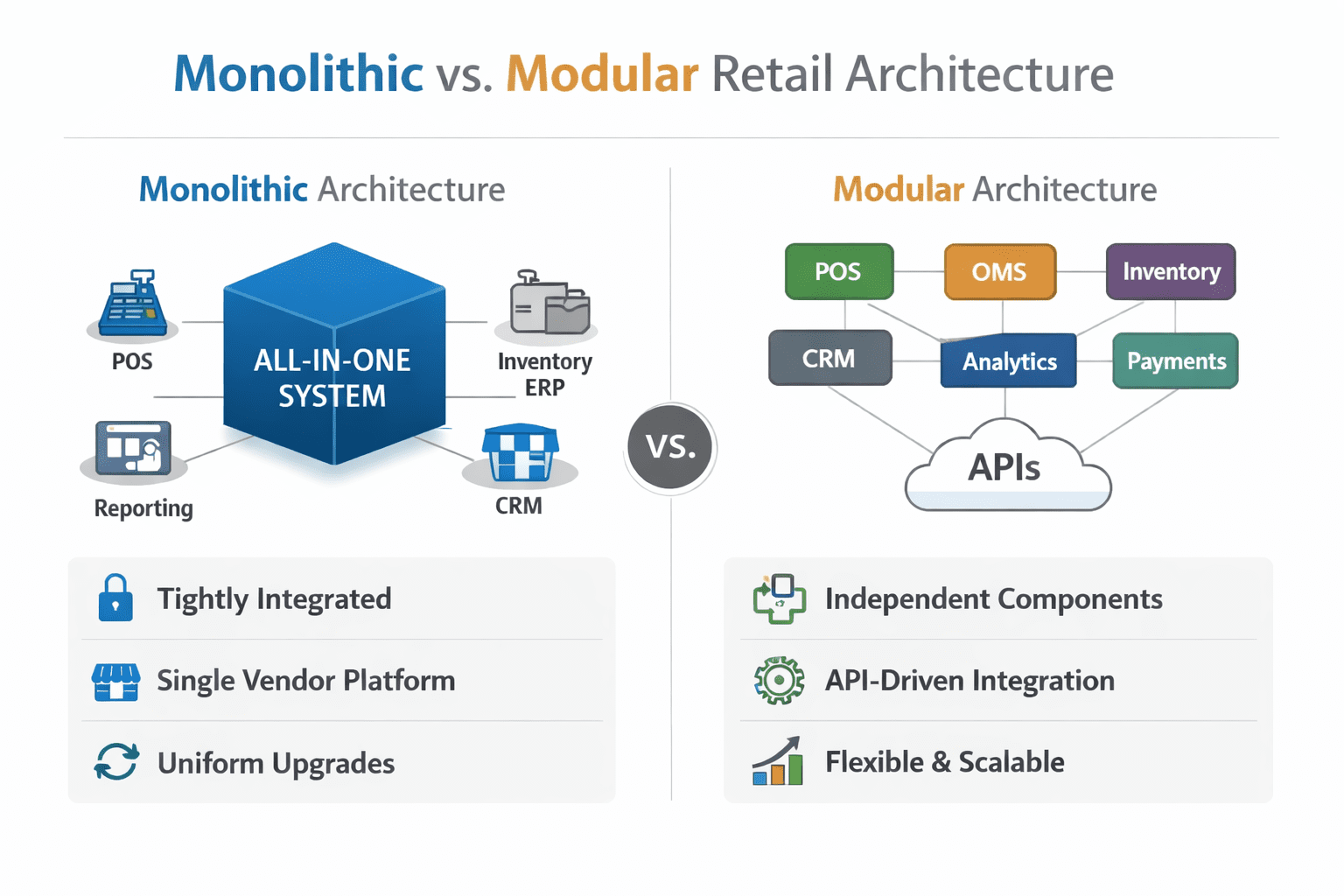
| Dimension | Monolithic Architecture | Modular Architecture |
| System Structure | Single, tightly integrated platform handling all major retail functions | Independent systems connected through APIs |
| Flexibility | Limited flexibility; changes often impact the entire system | High flexibility; components can evolve independently |
| Integration Approach | Primarily internal integrations within one vendor ecosystem | API-driven integrations across multiple systems |
| Vendor Dependency | High reliance on a single vendor | Reduced lock-in; best-of-breed selection possible |
| Customization | Complex and system-wide | Targeted and component-specific |
| Upgrade Cycles | Uniform upgrades affecting the entire platform | Independent upgrades by module |
| Scalability Model | Vertical scaling within the same architecture | Horizontal scaling by adding or replacing services |
| Innovation Speed | Slower, tied to vendor roadmap | Faster, driven by modular enhancements |
| Operational Complexity | Lower initial complexity | Higher architectural planning required |
| Risk Profile | Single system dependency risk | Distributed system management risk |
| Best Fit For | Stable, less complex retail environments | Dynamic, omnichannel, evolving retail ecosystems |
Where Monolithic Systems Still Make Sense
Despite the growing conversation around modular architecture, monolithic systems are not obsolete. In fact, in certain environments, they continue to offer strong advantages.
For small or mid-size retailers, operational complexity is often limited. A single integrated platform can provide sufficient functionality without the need for multiple integrations or architectural planning. The simplicity of having one system and one vendor can reduce decision fatigue and management overhead.
Monolithic systems also work well in environments with limited channel complexity. If a retailer operates primarily through physical stores, with minimal online integration or marketplace exposure, the need for API-driven modular flexibility may not justify the added complexity.
When integration requirements are low, a unified system can deliver faster implementation and easier governance. Retailers with stable supply chains, straightforward inventory flows, and minimal third-party dependencies often benefit from this centralized structure.
In controlled operating environments, such as single-country operations with uniform compliance requirements, a monolithic system can provide reliability and predictability. There is less need to adapt to varying tax structures, regulatory differences, or regional business models.
Finally, for cost-sensitive deployments, monolithic systems may present lower initial implementation costs. Managing one vendor relationship and one technology stack can reduce short-term financial and operational strain.
In these contexts, the question is not whether monolithic architecture is outdated, but whether flexibility is truly required.
Why Modular Architecture Is Gaining Momentum
While monolithic systems remain relevant in certain scenarios, modular architecture is gaining traction as retail complexity increases. Several structural shifts are driving this momentum.
A. Omnichannel Complexity
Retailers today operate across multiple sales channels, physical stores, eCommerce platforms, marketplaces, mobile apps, and even social commerce. Managing these channels requires seamless coordination between systems.
Real-time inventory visibility has become essential. Customers expect accurate availability across channels, and operational decisions depend on up-to-date stock information. Modular systems, built with API connectivity, enable real-time data exchange more effectively.
Integrated customer journeys, where discovery, purchase, fulfillment, and returns happen across different touchpoints, require systems that can communicate fluidly. Modular architecture supports this interconnected ecosystem.
B. Rapid Feature Evolution
Retail technology is evolving quickly. Payment methods, marketplace integrations, loyalty tools, and analytics platforms are constantly advancing.
Retailers need the flexibility to integrate new payment solutions, connect with marketplace partners, and adopt advanced analytics tools without overhauling their entire system. Modular architecture allows specific components to evolve independently, enabling faster innovation cycles.
C. Risk Mitigation
Relying entirely on a single system creates long-term dependency risks. If the vendor roadmap slows, or if the system struggles to adapt, retailers may face large-scale replatforming challenges.
Modular architecture distributes this risk. Retailers can upgrade or replace individual components gradually, reducing the operational disruption associated with full-system transitions.
D. Scalability Across Regions
As retailers expand across regions, they encounter varying tax structures, compliance rules, currency requirements, and business models.
A modular approach enables localized adjustments without redesigning the entire system architecture. Retailers can integrate region-specific tools or adapt modules independently, making geographic expansion more manageable.
Hidden Challenges of Modular Systems
While modular architecture offers flexibility and long-term adaptability, it is not without challenges. In fact, the very strengths that make modular systems attractive can also introduce operational complexity if not managed properly.
One of the primary challenges is integration complexity. Connecting multiple independent systems requires careful planning, testing, and maintenance. APIs must be designed thoughtfully to ensure accurate and consistent data exchange. Without disciplined integration management, data inconsistencies can emerge across inventory, orders, or customer records.
Closely related is the need for strong API governance. As more systems connect, controlling data flow, managing version updates, and ensuring security becomes critical. Poor governance can lead to performance bottlenecks, security vulnerabilities, or breakdowns in communication between systems.
Modular systems also demand higher initial architecture planning. Unlike monolithic platforms that arrive as a packaged solution, modular environments require retailers to design how components interact. Decisions made early, around data models, integration layers, and system responsibilities, have long-term consequences.
Finally, modular architecture places greater emphasis on internal technology maturity. Retailers must possess or develop the capability to manage vendor relationships, monitor integrations, and oversee architectural coherence. Without sufficient internal expertise, modular systems can become fragmented rather than flexible.
In short, modular architecture rewards preparedness. It provides agility, but only when supported by disciplined technical leadership and governance.
The Real Strategic Question
The discussion between monolithic and modular architecture is often framed as a binary choice. In reality, it is rarely that simple.
The more important question is not which model is universally superior, but which model aligns with the retailer’s strategic direction.
It depends on business model complexity. A retailer operating across multiple channels, fulfillment models, and geographies will likely require greater architectural flexibility than one operating in a controlled, single-format environment.
It depends on growth ambitions. Retailers planning aggressive expansion, marketplace integration, or rapid feature evolution may benefit from modular flexibility. Those focused on steady, contained growth may prioritize stability.
It depends on internal technology capability. Organizations with strong in-house technology teams can effectively manage modular ecosystems. Those without such resources may prefer centralized vendor accountability.
And it depends on long-term flexibility requirements. Architecture decisions compound over time. Retailers must consider not only current needs, but how adaptable their systems need to be over the next five to ten years.
Ultimately, architecture is not a technology debate. It is a strategic alignment decision, one that shapes how resilient, adaptable, and scalable a retail organization can become.
Conclusion: Architecture Shapes the Future of Retail
The choice between monolithic and modular retail systems is not about following industry trends. It is about strategic alignment.
Monolithic architecture provides simplicity, centralized control, and operational stability. For retailers with contained complexity, this model can continue to deliver reliability and ease of management. Modular architecture, however, reflects the growing demands of modern retail, interconnected channels, real-time data needs, and continuous evolution. It offers flexibility and long-term adaptability, but requires stronger governance and technical maturity.
The real decision lies in understanding the direction of the business. How complex will operations become? How quickly will the retail model evolve? How important is flexibility over the next five to ten years?
In the end, individual features may change, but architectural foundations define how easily a retailer can adapt. Choosing the right structure today determines how resilient and agile the organization will be tomorrow.
At Olabi, we believe retail architecture should not limit growth. Our approach is designed to balance control with flexibility, helping retailers build systems that scale without sacrificing visibility or operational discipline.
If you’re evaluating your current retail architecture or planning for future expansion, Schedule a demo with Olabi to explore how the right structural foundation can support your next phase of growth.
Share This Story, Choose Your Platform!
About the Author: Olabi

