
Olabi Sutras
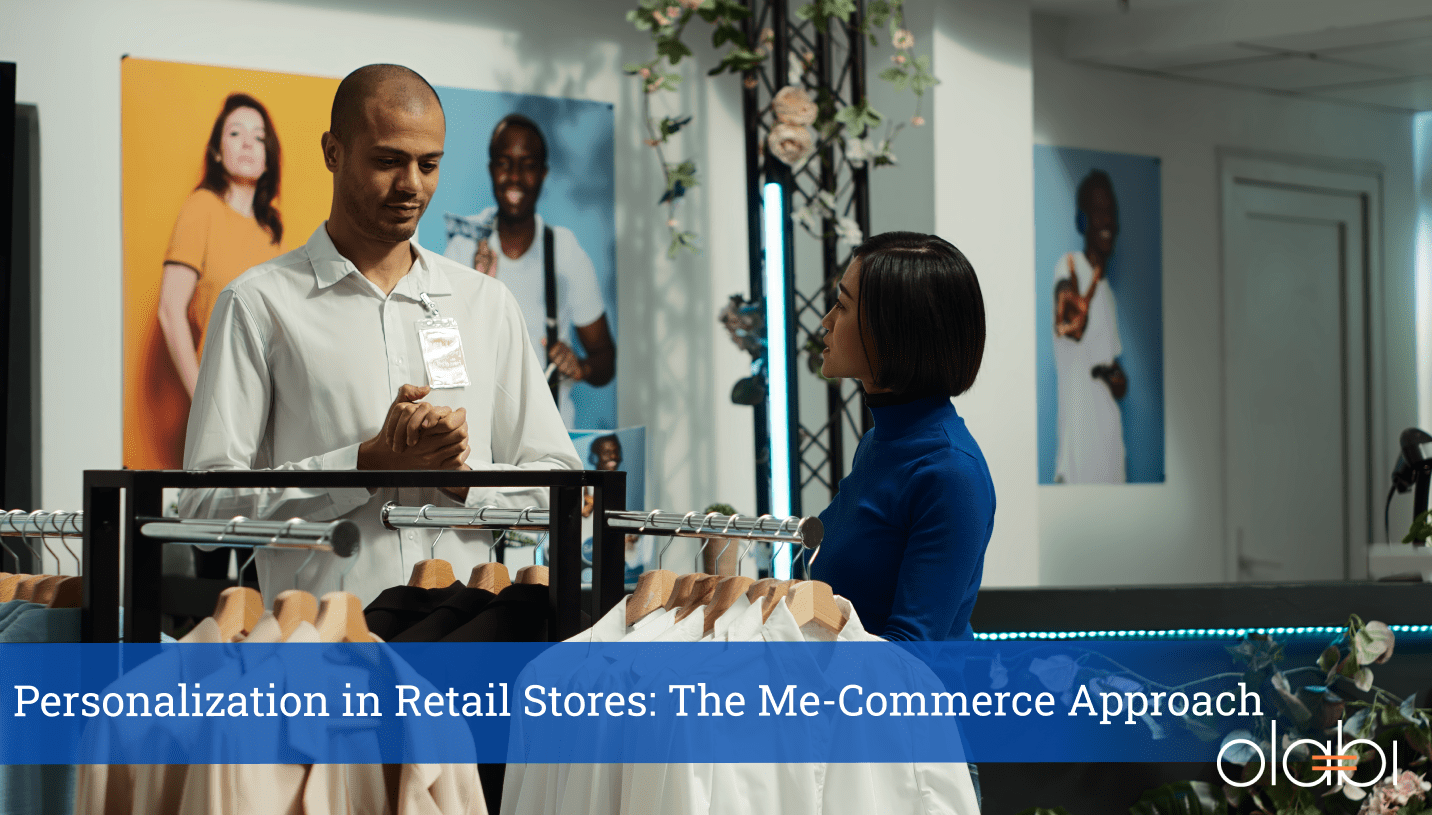
Personalization in Retail Stores: The Me-Commerce Approach to Modern Retail.
Personalization in retail stores has moved far beyond generic offers and loyalty discounts. Today’s shoppers expect relevant, individualized experiences inside the store, powered by their preferences, purchase history, and real-time context.
This shift has given rise to Me-Commerce, an approach to retail that puts the individual customer at the center of every interaction. Instead of designing experiences around channels or stores, Me-Commerce enables retailers to deliver meaningful personalization at the moment it matters most: in-store.
What Is Personalization in Retail Stores?
Personalization in retail stores refers to the ability to tailor in-store experiences, offers, and interactions to individual customers rather than applying the same approach to every shopper.
Unlike generic customization, such as store-wide discounts or broad customer segments, true personalization is customer-specific and contextual. It considers who the customer is, what they have purchased before, their loyalty status, and what they are engaging with in real time.
For personalization to be effective in physical retail, it must:
- Work in real time, not after the transaction
- Be available at the store level, not just online
- Be powered by unified customer and transaction data
Without real-time visibility and integrated systems, personalization remains limited to marketing campaigns rather than becoming part of the in-store experience.
Why Traditional Retail Personalization Falls Short
Many retailers invest in personalization initiatives, yet the in-store experience often remains largely generic. The reason is not a lack of intent, but the limitations of traditional personalization models.
Most retail personalization relies on broad customer segments rather than individuals. Shoppers are grouped by age, location, or spend level, resulting in mass offers that feel impersonal and fail to reflect real preferences or intent.
Personalization is also heavily skewed toward online channels. While ecommerce platforms use browsing behavior and click data effectively, physical stores often operate without the same level of insight. Store teams rarely have visibility into a customer’s history or preferences at the moment of interaction.
Another critical gap is the absence of real-time data inside stores. By the time customer data is processed, the shopping moment has already passed, making personalization reactive rather than contextual.
Finally, personalization breaks down due to siloed systems. POS, loyalty platforms, CRM, and ecommerce systems operate independently, creating fragmented customer views. Without a unified profile, personalization becomes inconsistent and unreliable.
These limitations explain why many personalization efforts fail to drive meaningful in-store impact and why a new approach is required.
What Is Me-Commerce? (And How It Redefines In-Store Personalization)
Me-Commerce represents a shift from channel-centric retail to customer-centric retail. Instead of designing experiences around stores, platforms, or touchpoints, Me-Commerce focuses on the individual customer at the center of every interaction.
In a Me-Commerce model, personalization is driven by who is shopping, not where the interaction happens. Whether the customer engages online, in-store, or across channels, their experience is guided by a single, unified customer profile.
This approach enables:
- One customer, one profile across all touchpoints
- Context-aware personalization inside the store
- Continuous experiences that adapt in real time
With Me-Commerce, in-store personalization is no longer limited to static offers or loyalty tiers. It becomes contextual, continuous, and actionable, empowering store teams to deliver relevant experiences at the moment of engagement.
How Me-Commerce Enables Personalization in Retail Stores
For personalization to work inside physical stores, it must be operationally embedded, not layered on as a marketing tactic. Me-Commerce enables this by connecting customer data, store systems, and real-time context into a single execution framework.
Unified Customer Profiles Across Channels
Me-Commerce starts with a single, unified view of the customer across all retail touchpoints. Instead of maintaining fragmented records across POS, ecommerce, and loyalty systems, customer data is consolidated into one profile.
This unified profile typically includes:
- Purchase history across channels
- Loyalty status and benefits
- Returns and exchange behavior
- Engagement across digital and in-store touchpoints
With this foundation, personalization inside the store becomes consistent and informed. Store interactions are no longer disconnected from past behavior, enabling more relevant recommendations and service at every visit.
Real-Time Context at the Store Level
True in-store personalization depends on real-time context, not historical data alone. Me-Commerce equips store teams with live visibility into both the customer and the environment they are shopping in.
Key enablers include:
- Store associate access to customer context during interactions
- Location-aware personalization based on the store or aisle
- Live inventory visibility to support recommendations and alternatives
By combining customer intent with real-time availability, Me-Commerce ensures personalization is practical and actionable, rather than aspirational.
Personalized Offers Without Manual Overrides
One of the biggest risks in in-store personalization is reliance on manual overrides, which create inconsistency and operational chaos. Me-Commerce replaces ad-hoc decision-making with rule-based personalization.
This allows retailers to:
- Apply loyalty-tier-based pricing or benefits automatically
- Trigger personalized offers without store-level intervention
- Maintain consistency across stores and channels
By eliminating manual overrides, retailers protect data integrity, reduce errors, and ensure personalization scales predictably without compromising governance.
Personalization Use Cases Inside the Store
Personalization becomes valuable only when it translates into real actions during the store visit. Me-Commerce enables practical, scalable use cases that store teams can execute without added complexity.
Personalized recommendations at billing
At checkout, recommendations are driven by the customer’s past purchases and preferences, such as complementary items or repeat buys, making upsell suggestions relevant rather than generic.
Loyalty-aware pricing or benefits
Customers automatically receive benefits aligned to their loyalty tier, such as exclusive pricing, early access, or value-added services, without store staff needing to manually apply overrides.
Endless aisle suggestions when items are unavailable
When an item is out of stock, store teams can recommend available alternatives across other stores or warehouses, ensuring the sale is not lost due to local inventory limitations.
Clienteling for high-value customers
Store associates can recognize repeat or high-value customers and offer personalized service, curated recommendations, or priority assistance based on their engagement history.
Personalized returns and exchanges
Returns and exchanges are handled with full visibility into purchase history and eligibility, allowing faster resolution while maintaining consistent policies and customer satisfaction.
The Role of Data Discipline in In-Store Personalization
Personalization inside retail stores is only as strong as the data discipline behind it. Without accurate, consistent data, even the best personalization strategies fail at execution.
Personalization depends on clean and reliable customer and item data. Errors in item definitions, pricing, or customer identifiers directly translate into broken offers, incorrect recommendations, and inconsistent experiences.
Key foundations of data discipline include:
- Item master accuracy
Correct item attributes, categories, pricing, and tax data ensure personalization logic behaves predictably across stores and channels. - Pricing and promotion consistency
Personalized offers must align with centrally defined pricing and promotion rules to avoid store-level discrepancies and margin leakage. - Unified customer identifiers
A single customer identity across POS, loyalty, and digital platforms is essential for delivering consistent experiences and tracking behavior accurately.
Data discipline is not a system problem, it is a leadership responsibility. Retail leaders must enforce ownership, governance, and validation at the data level to ensure personalization scales without operational risk.
Measuring the Impact of Personalization in Retail Stores
For retail leaders, personalization must deliver measurable business outcomes, not just better experiences. The impact should be tracked using metrics that reflect both customer value and commercial performance.
Key metrics include:
- Repeat purchase rate: Indicates whether personalized experiences are driving customers back to the store
- Average order value (AOV): Measures the effectiveness of personalized recommendations and upsell
- Loyalty participation: Shows engagement and adoption of personalized benefits
- Conversion rate: Reflects how well in-store interactions turn intent into transactions
- Customer lifetime value (CLV): Captures the long-term revenue impact of personalized experiences
How Retailers Can Get Started with Me-Commerce
Adopting Me-Commerce does not require a complete overhaul on day one. Successful retailers take a phased, disciplined approach that balances execution speed with governance.
Unify customer and transaction data
Start by connecting POS, ecommerce, and loyalty data to build a single, reliable customer view.
Fix item master and pricing consistency
Ensure item attributes, pricing rules, and promotions are accurate and governed centrally before introducing personalization logic.
Enable store teams with context, not complexity
Provide associates with relevant customer insights at the point of interaction—without adding operational burden or manual work.
Start with simple personalization use cases
Focus on practical scenarios such as loyalty benefits, basic recommendations, or endless aisle suggestions before expanding.
Scale gradually across stores
Standardize processes, validate outcomes, and then roll out personalization consistently across locations.
Conclusion: Personalization Is No Longer Optional
Modern retail is no longer driven by channels, campaigns, or transactions, it is driven by individual customers. Shoppers expect experiences that recognize who they are, reflect their preferences, and remain consistent across every touchpoint, including the store.
In this environment, in-store personalization becomes a true competitive advantage. Retailers that can translate customer context into relevant, real-time experiences differentiate themselves not through discounts, but through relevance, consistency, and trust.
This is where Me-Commerce, enabled by platforms like Olabi, changes the equation. Olabi’s Me-Commerce approach places the individual customer at the center of retail operations, turning personalization from a periodic marketing initiative into an embedded, scalable capability across stores and channels.
Retailers who invest in Me-Commerce with Olabi move beyond short-term promotional tactics. They build long-term loyalty, repeat engagement, and sustainable growth, supported by disciplined data foundations and predictable execution at scale. Schedule a demo with us to know more.
Share This Story, Choose Your Platform!
About the Author: Olabi

