
Olabi Sutras

Customer Retention in Retail: What Keeps Customers Coming Back?
Today’s retail customers have more choices than ever before. With countless brands competing for attention across stores, websites, marketplaces, and social commerce platforms, earning a customer’s first purchase is only half the battle. The real challenge is encouraging them to come back.
While customer acquisition remains important, sustainable retail growth increasingly depends on customer retention. Retained customers are more likely to make repeat purchases, engage with loyalty programs, recommend brands to others, and contribute greater value over time. In contrast, retailers that focus solely on acquiring new customers often face rising marketing costs and inconsistent growth.
Customer retention is no longer just a loyalty initiative. It is the result of delivering consistent experiences, maintaining product availability, providing convenience, and building meaningful customer relationships. Retailers that excel in these areas are far more likely to earn repeat business and long-term customer loyalty.
In this blog, we explore what customer retention means in modern retail and the key factors that keep customers coming back.
What Is Customer Retention in Retail?
Customer retention refers to a retailer’s ability to encourage customers to continue purchasing from the brand over an extended period of time. It measures how successfully a business can turn first-time buyers into repeat customers and build lasting customer relationships.
Unlike customer acquisition, which focuses on attracting new shoppers, customer retention focuses on keeping existing customers engaged and satisfied. While acquiring new customers is essential for growth, retaining existing customers is often more cost-effective and profitable in the long run.
Strong customer retention is built on repeat purchases and positive customer experiences. When customers consistently find value in a retailer’s products, services, and shopping experience, they are more likely to return rather than switch to a competitor. Over time, these repeat interactions help strengthen trust and deepen customer loyalty.
Customer retention is particularly important because loyal customers often contribute a disproportionate share of revenue. They tend to purchase more frequently, spend more per transaction, and are more likely to recommend the brand to friends and family. As a result, retailers with strong customer retention strategies are often better positioned to achieve sustainable growth, improve profitability, and build a more resilient business.
Why Customer Retention Has Become a Critical Retail KPI
Customer retention has become one of the most important indicators of retail success. Modern consumers have access to more brands, more shopping channels, and more purchasing options than ever before. With lower switching barriers and rising customer expectations, retaining existing customers has become increasingly challenging.
At the same time, acquiring new customers continues to become more expensive due to growing competition and increasing marketing costs. As a result, retailers are placing greater emphasis on retention as a driver of long-term growth and profitability.
Strong customer retention helps retailers increase customer lifetime value, generate repeat purchases, and reduce dependence on continuous customer acquisition. It also creates a more stable revenue base, allowing businesses to grow more efficiently. Customers who continue to return are often a reflection of positive shopping experiences, effective service delivery, and strong brand trust.
For modern retailers, customer retention is no longer just a marketing metric. It is a key business KPI that reflects customer satisfaction, operational performance, and overall brand health.
The Customer Retention Journey: What Keeps Customers Coming Back?
Customer retention is rarely the result of a single interaction. Instead, it is built through a series of positive experiences that consistently deliver value to the customer. Every touchpoint, from product discovery to post-purchase support, plays a role in shaping whether a customer returns or chooses a competitor.
The customer retention journey can be visualized as follows:
Customer Retention Flow
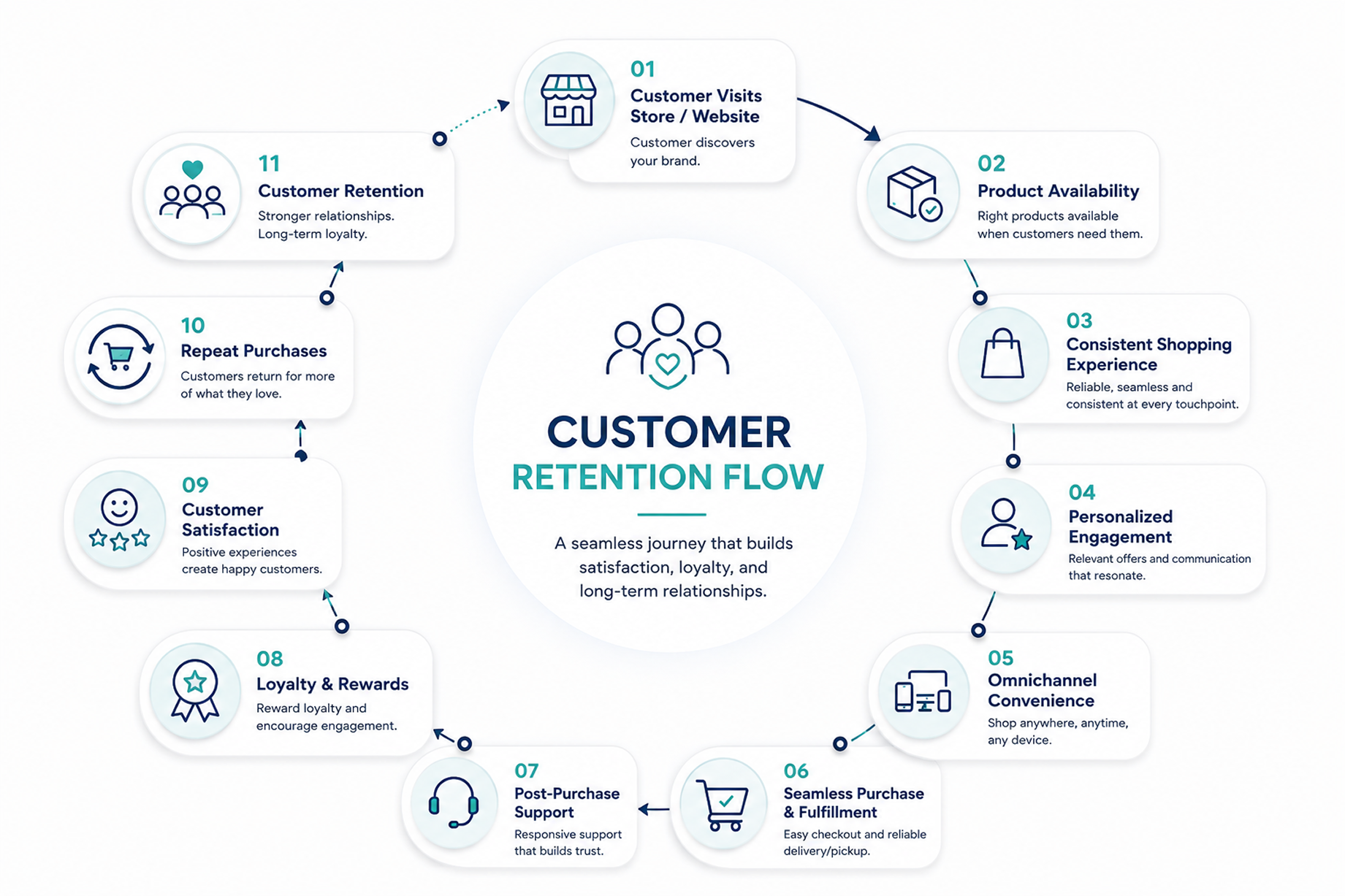
Each stage in this journey influences customer loyalty. A customer may appreciate a retailer’s products, but repeated stockouts can discourage future purchases. Similarly, strong product availability may not be enough if the shopping experience is inconsistent across channels.
Retailers that successfully retain customers understand that loyalty is built through the combined impact of product availability, customer experience, convenience, personalization, and service. When these elements work together, customers are more likely to return, spend more frequently, and develop stronger relationships with the brand.
The following factors represent the most important drivers of customer retention in modern retail.
Factor 1: Deliver Consistent Customer Experiences
Consistency is one of the strongest drivers of customer retention. Customers are more likely to return to retailers that deliver reliable and predictable experiences every time they interact with the brand. Whether customers are shopping in-store, browsing online, contacting customer support, or engaging after a purchase, they expect the same level of service and convenience throughout their journey.
Inconsistent experiences can quickly damage trust. A retailer may offer an excellent in-store experience, but if the website is difficult to navigate or customer support is unresponsive, customers may choose to shop elsewhere. Similarly, differences in pricing, promotions, or product information across channels can create frustration and reduce customer confidence.
Retailers that focus on delivering a consistent experience across every touchpoint are better positioned to build trust, strengthen customer relationships, and encourage repeat purchases. Over time, this consistency becomes a key factor in keeping customers loyal to the brand.
Factor 2: Ensure Product Availability When Customers Need It
Few things damage customer loyalty faster than finding a product out of stock. Regardless of how strong a retailer’s marketing, loyalty program, or customer experience may be, customers cannot purchase products that are unavailable.
Product availability plays a critical role in customer retention because it directly influences customer satisfaction. When customers consistently find the products they need, they are more likely to return for future purchases. Conversely, repeated stockouts often push customers to competitors who can fulfill their needs immediately.
Achieving high product availability requires accurate inventory visibility, effective replenishment planning, and strong inventory management practices. Retailers must understand inventory levels across stores, warehouses, and fulfillment locations to ensure products remain accessible across all channels.
In today’s competitive retail environment, product availability has become a customer experience factor rather than simply an inventory management concern. Retailers that consistently deliver the right products at the right time are far more likely to earn customer trust and long-term loyalty.
Factor 3: Personalize Customer Interactions
Modern customers expect retailers to understand their preferences and provide experiences that feel relevant to their individual needs. Generic promotions and one-size-fits-all marketing campaigns are becoming less effective as customers increasingly seek personalized shopping experiences.
Personalization can take many forms, including product recommendations based on previous purchases, targeted promotions, tailored communication, and customized offers. By leveraging customer data and purchase history, retailers can deliver more relevant interactions that improve engagement and strengthen customer relationships.
Personalized experiences also make customers feel recognized and valued. When retailers consistently provide relevant recommendations and offers, customers are more likely to perceive the brand as helpful rather than transactional. This creates stronger emotional connections and encourages repeat purchases.
As customer expectations continue to evolve, personalization has become an important component of customer retention strategies. Retailers that effectively use customer insights to create meaningful experiences are better positioned to build long-term loyalty.
Factor 4: Build Loyalty Beyond Discounts
Many retailers rely heavily on discounts to encourage repeat purchases. While promotions can drive short-term sales, they rarely create lasting customer loyalty on their own. Customers who return only for discounts are often willing to switch brands as soon as a better offer becomes available.
Successful customer retention strategies focus on creating value beyond price reductions. Loyalty programs, exclusive benefits, personalized rewards, early access to new products, and customer recognition initiatives can help strengthen customer relationships and encourage long-term engagement.
The most effective loyalty programs reward customers for their ongoing relationship with the brand rather than simply incentivizing individual transactions. When customers feel appreciated and receive benefits that align with their preferences, they are more likely to remain loyal even in highly competitive markets.
Ultimately, sustainable customer retention is built on trust, convenience, and positive experiences. Discounts may attract customers initially, but meaningful loyalty is earned through consistent value and strong customer relationships.
Factor 5: Create Seamless Omnichannel Experiences
Today’s customers expect the flexibility to move effortlessly between online and offline channels during their shopping journey. They may discover a product online, visit a store to experience it, place an order through a mobile app, and choose home delivery or in-store pickup. To the customer, these interactions are part of a single shopping experience.
Retailers that provide seamless omnichannel experiences make it easier for customers to engage with the brand whenever and however they choose. Consistent product information, synchronized inventory visibility, unified promotions, and flexible fulfillment options help eliminate friction throughout the purchasing journey.
When channels operate independently, customers often encounter inconsistencies that create frustration and reduce trust. In contrast, a connected omnichannel experience improves convenience and encourages repeat purchases by making shopping simpler and more reliable.
As customer expectations continue to evolve, omnichannel retail has become a key contributor to customer retention and long-term loyalty.
Factor 6: Make Convenience a Competitive Advantage
Convenience has become one of the most important factors influencing customer purchasing decisions. In many cases, customers choose retailers not because they offer the lowest prices, but because they make shopping easier and more efficient.
Convenience can take many forms, including fast checkout processes, multiple payment options, flexible delivery methods, easy returns, and simplified customer support. Each of these elements reduces friction and improves the overall shopping experience.
Retailers that consistently remove obstacles from the customer journey make it easier for shoppers to complete purchases and return for future transactions. Over time, this convenience becomes a competitive advantage that differentiates a retailer from competitors offering similar products.
In a retail environment where customers value speed and simplicity, convenience is no longer a nice-to-have feature. It is an essential driver of customer satisfaction, loyalty, and retention.
Factor 7: Use Customer Data to Understand Retention Drivers
Improving customer retention requires more than intuition. Retailers need a clear understanding of why customers return, what influences their purchasing decisions, and where opportunities exist to strengthen customer relationships. This is where customer data becomes invaluable.
By analyzing customer behavior, purchase history, shopping frequency, and engagement patterns, retailers can identify the factors that contribute most to retention. Metrics such as repeat purchase rate, customer lifetime value, average order value, and retention rate provide valuable insights into customer loyalty and overall business performance.
Customer analytics can also help retailers identify at-risk customers before they stop purchasing altogether. By recognizing changes in buying behavior, retailers can take proactive measures through targeted promotions, personalized communication, or loyalty incentives to re-engage those customers.
As retail competition continues to intensify, data-driven decision-making has become essential for customer retention. Retailers that effectively leverage customer insights are better equipped to create relevant experiences, strengthen loyalty, and maximize long-term customer value.
Common Mistakes That Hurt Customer Retention
Many retailers invest heavily in acquiring new customers while unintentionally overlooking issues that drive existing customers away. Even small gaps in the customer experience can gradually erode loyalty over time.
One of the most common retention challenges is frequent stockouts. Customers who repeatedly encounter unavailable products often seek alternatives elsewhere. Poor customer service can have a similar effect, as unresolved issues and slow response times damage trust and satisfaction.
Generic customer engagement is another common mistake. Customers increasingly expect personalized experiences, and generic promotions or irrelevant communications can reduce engagement rather than strengthen it. Inconsistent experiences across online and offline channels can also create friction that discourages repeat purchases.
Finally, retailers that rely too heavily on discounts may attract price-sensitive shoppers without building genuine loyalty. While promotions can encourage short-term sales, long-term customer retention is built through value, convenience, trust, and positive experiences.
Avoiding these common mistakes is often just as important as implementing new retention initiatives. Retailers that consistently address customer needs and remove friction from the shopping journey are far more likely to build lasting customer relationships.
The Future of Customer Retention in Retail
Customer retention strategies are evolving rapidly as retailers gain access to more customer data and advanced technologies. Traditional retention efforts focused primarily on loyalty programs and promotional campaigns. Today, retailers are increasingly using data-driven insights to understand customer behavior and create more personalized experiences.
Artificial intelligence and predictive analytics are helping retailers identify purchasing patterns, forecast customer needs, and anticipate churn risks before they occur. This enables businesses to engage customers proactively with relevant recommendations, targeted offers, and personalized communications.
At the same time, unified customer data is providing retailers with a more complete view of customer interactions across stores, websites, mobile applications, and other channels. This visibility allows brands to deliver more consistent and connected experiences throughout the customer journey.
As customer expectations continue to rise, retention strategies will become increasingly experience-driven rather than transaction-driven. Retailers that leverage data, technology, and personalization effectively will be better positioned to build stronger customer relationships and maintain a competitive advantage.
Conclusion:
Customer retention is one of the most important drivers of sustainable retail growth. While attracting new customers remains essential, long-term success depends on a retailer’s ability to consistently deliver experiences that encourage customers to return.
From product availability and personalized engagement to omnichannel convenience and customer service, every interaction influences whether a customer remains loyal to a brand. Retailers that focus on delivering value throughout the customer journey are more likely to build stronger relationships, increase customer lifetime value, and improve overall profitability.
At Olabi, we help retailers strengthen customer retention through connected retail operations, unified customer insights, loyalty management, inventory visibility, and seamless omnichannel experiences. By bringing together customer, inventory, and operational data on a single platform, retailers can create better shopping experiences that keep customers engaged and coming back.
If your retail business is looking to improve customer loyalty, increase repeat purchases, and maximize long-term customer value, schedule a demo with Olabi and discover how connected retail operations can support stronger customer retention and sustainable business growth.
Share This Story, Choose Your Platform!
About the Author: Olabi

