
Olabi Sutras

Shop-in-Shop Model: The Hidden Struggle with Billing and Sales Tracking
The Shop-in-Shop model has become a popular strategy for retail brands to expand visibility and sales without setting up standalone stores. From lifestyle and fashion brands operating inside large department stores to consumer electronics counters within malls, Shop in Shop model allows brands to capture footfall and leverage host retailers’ infrastructure.
But beneath this seemingly efficient model lies a complex operational challenge: managing billing, reconciliation, and sales visibility. Unlike standalone outlets where a brand controls the entire point-of-sale process, Shop-in-Shop model setups often rely on the host retailer’s billing systems. This leads to multiple layers of dependency, delayed or inaccurate reconciliation, mismatched sales reports, and lack of real-time visibility into what’s actually selling.
For brands, the consequences are serious:
- Delayed settlements mean cash flow gaps.
- Inaccurate sales tracking prevents timely replenishment and demand forecasting.
- Limited visibility hinders marketing, promotions, and performance measurement.
In other words, while the Shop-in-Shop model is great for growth, it creates blind spots in financial and operational control.
The good news? With the right retail technology, such as unified POS platforms, integrated reconciliation tools, and real-time dashboards, brands can bridge these gaps. A centralized system gives brands direct visibility into sales, automates billing with host retailers, and ensures faster, more accurate settlements.
This article explores the hidden challenges of Shop-in-Shop model operations and how retail platforms can provide the clarity, control, and confidence brands need to make this model truly profitable.
The Hidden Struggles in Shop-in-Shop Models
The Shop-in-Shop model (SIS) retail format offers brands a unique opportunity to expand their presence within established retail environments. It allows them to capture footfall, leverage the host retailer’s infrastructure, and strengthen brand visibility without the cost of running independent stores.
However, behind the promise of shared spaces lies a set of operational complexities that often create friction between host retailers and brands. The biggest pain points emerge in three critical areas: billing, reconciliation, and sales visibility.
Billing Complexities
Billing in the Shop in Shop model is rarely straightforward. Since there are multiple stakeholders involved, the host retailer, the brand, and sometimes even third-party managers, the flow of transactions becomes tangled.
- Multiple stakeholders: Sales are recorded by the host retailer’s systems but belong to the brand, which complicates how billing statements are generated. Store managers often mediate between the two sides, adding yet another layer to the process.
- Manual errors: When billing depends on spreadsheets, manual entries, or fragmented POS integrations, inaccuracies creep in. Even small mistakes can create large disputes over settlements.
- Delayed settlements: With sales passing through the host’s systems before reaching the brand, delays in transferring revenue are common. This often strains cash flow, especially for brands with several SIS outlets.
- Margin and commission disputes: Negotiated terms on revenue sharing or commissions can get muddled in execution, leading to disagreements on how much is actually owed.
The result is a billing environment that is slow, error-prone, and prone to disputes, undermining the very efficiency Shop-in-Shop models are meant to bring.
Reconciliation Challenges
After billing, reconciliation emerges as another major hurdle. Brands often find it difficult to align their own financial records with the host retailer’s reporting systems.
- Mismatched data: POS data from the host may not sync with the brand’s internal sales records, leading to gaps and inconsistencies.
- Delayed adjustments: Credit notes, discounts, or returns are often reflected late in host reports, throwing off monthly or quarterly reconciliations.
- Revenue leakages: Without automated reconciliation, discrepancies can remain hidden, causing silent losses that eat into profitability.
These challenges not only create friction but also make it harder for brands to trust the numbers they’re receiving and ultimately, to plan effectively.
Sales Visibility Gaps
Perhaps the most critical challenge lies in visibility. In the Shop-in-Shop model, sales data is often fragmented across host systems and brand systems, making it difficult for brands to gain a clear, real-time view of performance.
- Fragmented systems: Each host retailer may run its own POS and reporting system, and without seamless integration, brands are forced to pull data from multiple dashboards or reports.
- Lack of real-time insights: Instead of instant visibility, brands often receive consolidated reports weekly or monthly, far too late for agile decision-making.
- Impact on forecasting and inventory planning: Without accurate sales visibility, demand forecasting becomes guesswork. Inventory may pile up in one Shop-in-Shop model outlet while running out in another, directly impacting consumer experience.
This lack of visibility means brands are essentially running blind, unable to optimize operations or respond to market demand as quickly as they should.
Solutions to Overcome These Challenges
The challenges in a Shop-in-Shop model are significant, but with the right technology and processes, brands can transform these pain points into opportunities for efficiency and growth. Below are some practical solutions:
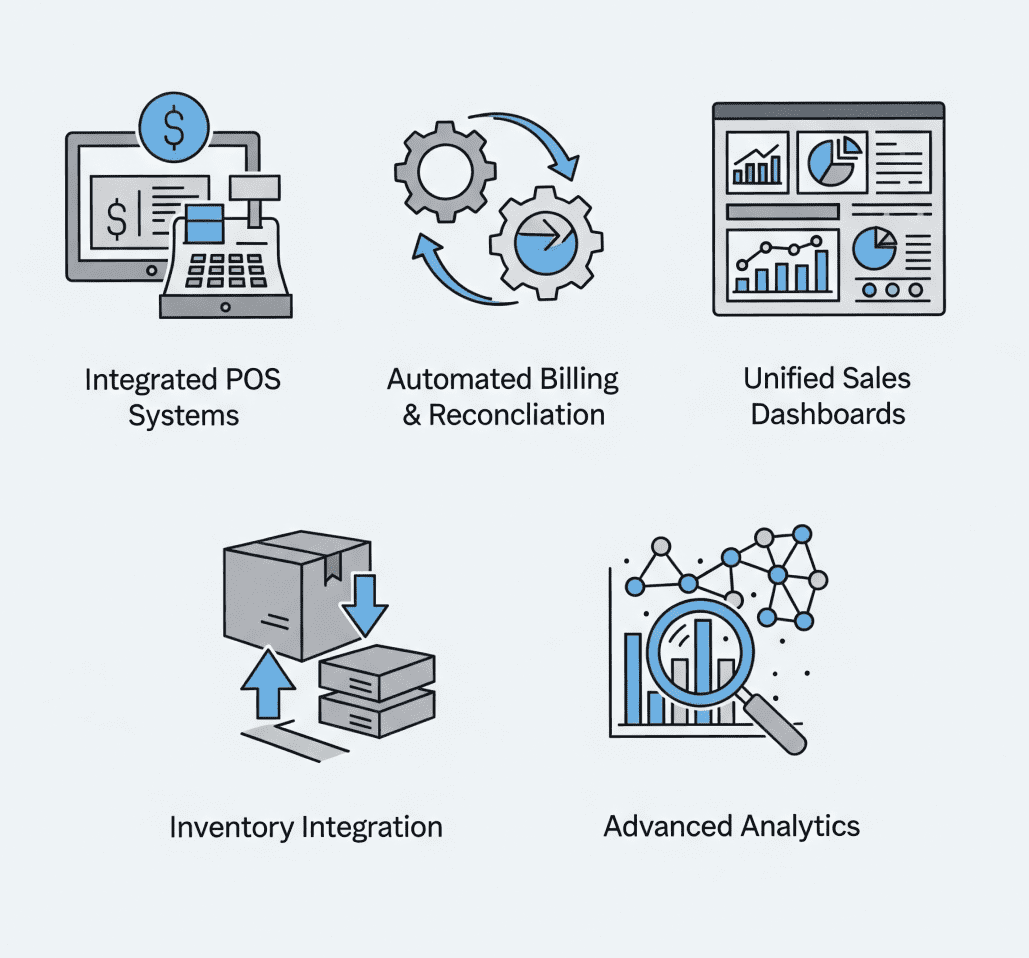
Integrated POS Systems
- Deploying a single POS solution across Shop-in-Shop model counters and host stores ensures consistency in transaction handling.
- Real-time synchronization allows every sale, commission, or settlement entry to be captured instantly, minimizing manual intervention.
- With shared infrastructure, both host retailers and brands benefit from uniform reporting and reduced operational friction.
Automated Billing & Reconciliation
- Instead of relying on manual calculations, auto-generated invoices can split revenues accurately between host retailers and brand owners.
- Commission percentages, GST, and settlement cycles can be preconfigured to eliminate disputes.
- Digital audit trails provide transparency, making settlements faster and more reliable.
Unified Sales Dashboards
- A centralized reporting dashboard consolidates sales data from multiple Shop-in-Shop model outlets in real time.
- Brand managers can track product performance across locations, compare host retailer contributions, and identify underperforming counters.
- Visibility into customer preferences enables brands to make quick, data-backed decisions on promotions and pricing.
Inventory Integration
- A direct connection between Shop-in-Shop model counters and the brand’s central warehouse ensures accurate stock flow.
- Automated replenishment reduces the risk of stockouts, while overstock alerts prevent unnecessary holding costs.
- With integrated inventory systems, brands can align stock movement with actual sales trends across all Shop-in-Shop model locations.
Advanced Analytics
- Using predictive analytics, brands can forecast demand more accurately by analyzing unified Shop-in-Shop model sales data.
- Insights into customer buying behavior help optimize product assortments, pricing, and promotions.
- Retailers can even use analytics to benchmark Shop-in-Shop model store performance against exclusive brand outlets, identifying improvement opportunities.
Conclusion
The shop-in-shop model has emerged as one of the most powerful retail formats, offering brands immediate access to new markets, wider visibility, and shared resources with host retailers. However, despite its advantages, SIS operations often struggle with fragmented systems, manual reconciliations, and lack of transparency in sales data. These inefficiencies not only consume time and resources but also eat into already thin retail margins, turning what should be a high-potential channel into a daily management challenge.
This is where technology becomes the differentiator. With Olabi’s retail solutions, SIS operations can be transformed from complex and error-prone to seamless and scalable. Our integrated POS ensures billing accuracy across locations, automated reconciliation eliminates disputes and delays, and real-time sales visibility provides brands with complete control over performance, even when operating across multiple partner stores.
By unifying processes and data, Olabi enables brands to maximize profitability, strengthen retailer relationships, and focus on consumer engagement rather than backend firefighting. In short, we help you unlock the true potential of the shop-in-shop model and turn it into a dependable growth engine.
If you’re looking to streamline and scale your Shop-in-Shop model operations with confidence, Olabi can help.
Share This Story, Choose Your Platform!
About the Author: Olabi

