
Olabi Sutras

6 Master Data Management Mistakes That Cost Retailers Millions
In today’s hyper-connected retail environment, success hinges on operational accuracy and agility. Whether you’re managing hundreds of SKUs, launching seasonal collections, or scaling across online and offline channels, the integrity of your core retail data can make or break your business.
Yet Master Data Management (MDM) often remains an afterthought, leading to fragmented systems, bloated inventories, and decision paralysis. For enterprise retailers and franchise networks, the cost of poor Master Data Management isn’t just inefficiency; it’s millions in lost revenue, missed opportunities, and eroded brand trust.
Let’s take a closer look at what Master Data Management actually means in a retail context and why getting it wrong is more common (and costly) than most CXOs imagine.
What is Master Data Management in Retail?
Master Data Management (MDM) in retail refers to the centralized governance, accuracy, and consistency of your core business data, including products, customers, suppliers, locations, and pricing. It is the foundational layer that powers everything from inventory control and order fulfillment to marketing personalization and business analytics.
In simpler terms:
If your ERP, POS, eCommerce, and CRM systems don’t speak the same “data language,” your operations are only as good as your worst spreadsheet.
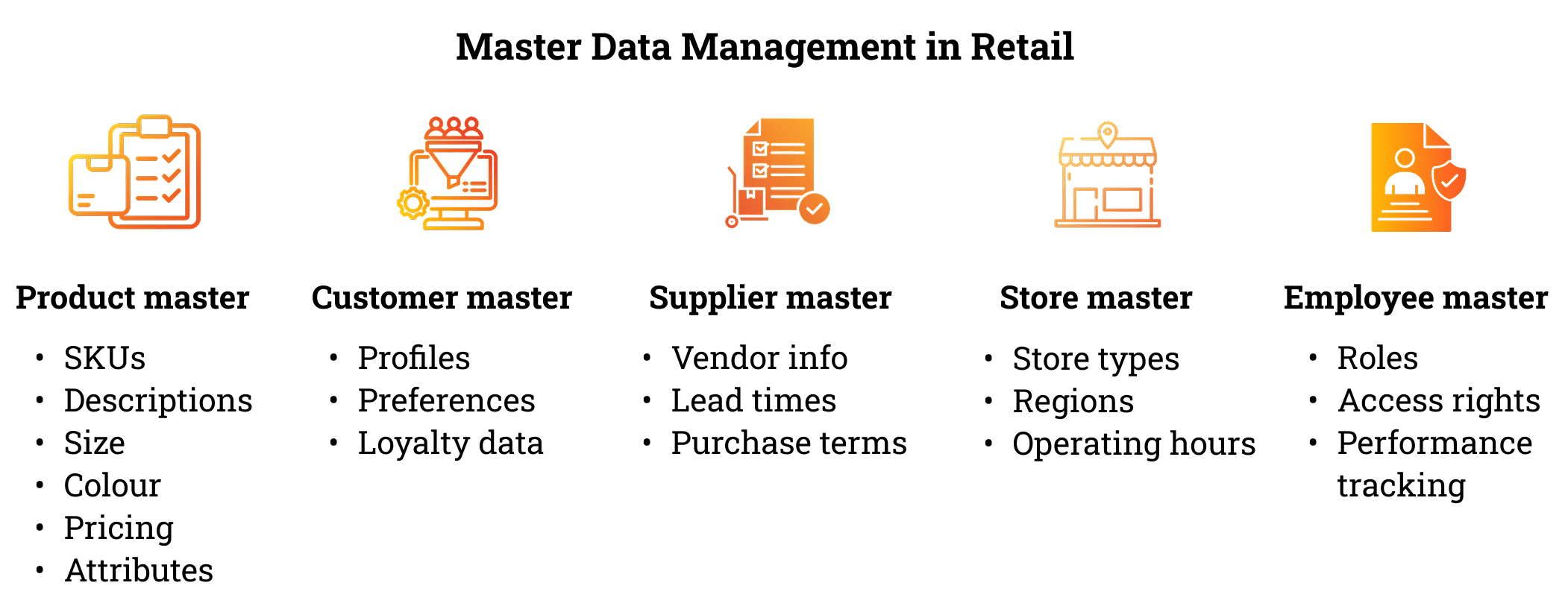
Here’s what typically falls under retail master data:
- Product master: SKUs, descriptions, size, color, pricing, attributes
- Customer master: Profiles, preferences, loyalty data
- Supplier master: Vendor info, lead times, purchase terms
- Store/location master: Store types, regions, operating hours
- Employee master: Roles, access rights, performance tracking
Effective Master data management ensures that a product added to the system in the HO is accurately reflected in every downstream system across warehouses, stores, and digital touchpoints. For large-scale retailers, it’s not just a backend tool; it’s a strategic asset.
Mistake #1: Decentralized and Siloed Systems
In many retail enterprises, different departments or regions operate in silos, each managing their own version of product, pricing, or customer data. What’s worse, these systems rarely communicate effectively.
The result? A product might be listed under one category in your POS, another in your e-commerce platform, and a third in your marketing database. Promotions may run on outdated SKUs. Inventory reports might not reflect actual stock across all channels.
Example: A regional manager launches a local promotion, but due to mismatched product codes across systems, it fails to sync with store POS terminals, leading to checkout issues and frustrated customers.
The Cost: Missed sales, inefficient store operations, and a broken omnichannel experience.
Mistake #2: Lack of Data Governance and Standards
Without clear data governance, anyone from the merchandising team to the store associate can input data into your systems, often using different naming conventions, units of measure, or category labels.
Over time, this leads to bloated databases filled with duplicates, inconsistent records, and incomplete fields. Teams waste hours cleaning up data manually, only to repeat the cycle next season.
Example: One team tags a T-shirt as “Topwear,” another as “Apparel > Tees.” Your reports now count them separately, skewing insights and forecasting.
The Cost: Slower decision-making, inaccurate reporting, and an ever-growing operational mess.
Mistake #3: No Single Source of Truth (SSOT)
Without a centralized system acting as the authoritative source for all master data, inconsistencies multiply. Different platforms pull from different data pools, leading to confusion and contradictory information across channels.
A customer sees one price online, a different price in-store. Your analytics dashboard shows one set of sales figures, while your finance team sees another. Trust erodes both internally and externally.
Example: During a clearance sale, the e-commerce store still lists old prices because the markdown wasn’t propagated from the ERP in time. Customers abandon carts. Inventory doesn’t move.
The Cost: Disconnected experiences, lost trust, and operational inefficiency at scale.
Mistake #4: Poor Product Hierarchy and Categorization
A weak or inconsistent product hierarchy doesn’t just mess with how products are displayed it affects everything from analytics to replenishment strategies.
When product categorization is arbitrary or outdated, retailers struggle with everything from inventory turns to customer segmentation. Your “Men’s Jackets” may be tagged as “Winterwear” in one region and “Outerwear” in another. Reporting becomes fragmented. Automation suffers. Merchandisers can’t plan accurately.
Example: A fashion retailer running a seasonal sell-through analysis finds that jackets under one category outperform, only to realize halfway through that identical products are filed under different tags elsewhere.
The Cost: Inaccurate insights, poor assortment planning, and sluggish supply chain decisions all compounding at scale.
Mistake #5: Ignoring Data in M&A, Store Expansions or System Migrations
Mergers, acquisitions, and new store launches are complex operations, and master data often gets overlooked in the rush to integrate operations or go live.
New stores might adopt existing POS systems but work with different product codes or vendor formats. Acquired brands may have legacy databases that don’t align with your central ERP. System migrations often lead to data loss, duplication, or even corruption, unless carefully managed.
Example: A retailer acquires a regional chain, only to discover six months later that supplier data wasn’t standardized, leading to duplicate vendor payments and conflicting purchase orders.
The Cost: Operational downtime, supply chain confusion, and avoidable financial leakage.
Mistake #6: Treating Master Data Management as a One-Time IT Project
Many retailers think of Master Data Management as a one-and-done implementation, something to tick off a checklist and forget. But in reality, MDM is a living discipline that requires ongoing governance, updates, and cross-team ownership.
Data changes constantly, new SKUs, changing vendor terms, evolving tax rules, and dynamic pricing models. Without continuous oversight, even the best systems decay.
Example: A retailer who last audited their product taxonomy two years ago finds that new product types have been force-fitted into outdated categories, rendering performance analytics nearly useless.
The Cost: Gradual decline in data quality, eroded confidence in systems, and decision-making based on flawed foundations.
How Modern Retailers Are Solving This
Forward-thinking retailers are no longer treating Master Data Management as a backend chore they’re embedding it into their core strategy.
Here’s how:
- Implementing Centralized Master Data Management Platforms: Retailers are moving toward centralized systems that unify product, vendor, inventory, and customer data across all functions and locations becoming the single source of truth.
- Establishing Clear Data Governance: Leading brands are appointing dedicated data stewards and creating standardized taxonomies, naming conventions, and approval workflows to avoid inconsistencies.
- Integrating Master Data Management with ERP & POS Systems: Seamless sync between ERP, POS, and e-commerce ensures updates are reflected across all platforms in real-time, avoiding customer-facing errors.
- Ongoing Data Audits & Cleanups: Instead of periodic cleanups, modern teams are adopting continuous monitoring tools and validation rules to keep data healthy, always.
- Training & Ownership: Retailers are investing in internal training and making master data a shared responsibility not just an IT concern.
Example: A lifestyle retail chain deployed an AI-assisted Master Data Management layer on top of its ERP system to auto-validate SKUs, flag duplicates, and correct attribute mismatches.
Result: 40% improvement in merchandising accuracy and a smoother omnichannel experience across all stores.
Conclusion:
Master data isn’t just an IT asset it’s the bedrock of operational excellence in retail. When managed right, it powers everything: accurate inventory, seamless omnichannel journeys, efficient procurement, personalized marketing, and actionable analytics.
But when neglected, it quietly eats away at profitability, productivity, and customer trust.
That’s exactly where Olabi comes in.
Our platform is designed to make Master Data Management simple, scalable, and accurate across stores, channels, and systems. From centralized product hierarchies to automated validations and real-time sync with ERP and POS, Olabi ensures your teams always work with clean, reliable data.
No more duplicates. No more misclassifications. No more broken processes.
Whether you’re managing 10 stores or 1,000, Olabi helps you maintain control without complexity.
Ready to stop losing money to bad data?
Schedule a demo with Olabi and see how we can help you fix your foundation and future-proof your retail operations.
Share This Story, Choose Your Platform!
About the Author: Olabi

