
Olabi Sutras

What Makes a Cloud POS Truly Scalable? A Technical Breakdown
Retail businesses today no longer ask whether they need a Cloud POS, they ask how to choose the one that will scale with them. As brands expand across geographies, channels, and customer touchpoints, a scalable Cloud POS isn’t just a nice-to-have, it’s critical infrastructure.
But what does scalability mean in the context of Cloud POS systems? Beyond buzzwords, true scalability refers to a system’s ability to handle increasing transaction volumes, user loads, and data complexity without compromising performance, availability, or security.
In this blog, we’ll break down the technical backbone of a truly scalable Cloud POS, from architecture and infrastructure choices to API management, real-time data handling, multi-location support, and more.
If you’re a CTO, retail operations head, or product leader evaluating your POS for long-term growth, this is the deep dive you need.
Understanding Scalability in the Context of Cloud POS
In the fast-paced world of retail, scalability isn’t just a nice-to-have, it’s a core requirement. But what exactly does scalability mean in the context of a Cloud POS system?
At its core, scalability refers to the system’s ability to handle increasing amounts of work or its potential to accommodate growth. This could mean supporting more transactions, more users, or more locations, without compromising performance, uptime, or user experience.
Vertical vs. Horizontal Scalability
- Vertical Scalability (Scaling Up): Increasing the power of a single server or instance, adding more CPU, memory, or storage.
- Horizontal Scalability (Scaling Out): Adding more instances or nodes to distribute the load. This is typically more sustainable and cost-effective in cloud-native environments.
A truly scalable Cloud POS leverages horizontal scaling to meet demand dynamically across geographies and store formats.
Real-World Triggers for Scale
- Holiday Rush: Transaction volumes spike significantly during sales events like Black Friday or Diwali.
- Store Expansion: New outlets, kiosks, or franchise locations require instant POS provisioning, often across regions or even countries.
- Sudden Demand Spikes: A viral product or influencer-driven sale can trigger a surge in online/offline orders.
Without scalability, these events can lead to performance lags, failed checkouts, or lost revenue. A cloud POS that’s architected for scale ensures smooth operations even under stress, keeping customers and cash registers moving.
Technical Foundations of a Scalable Cloud POS
To deliver true scalability, a cloud POS must be built on a robust technical foundation that supports seamless performance under varying loads. Below are the key components that enable such flexibility and resilience:
Cloud-Native Architecture
Modern cloud POS systems are designed using cloud-native principles, which means they are built from the ground up to operate in the cloud environment. This includes the use of:
- Microservices: Instead of one monolithic codebase, functionality is broken down into smaller, independent services (e.g., inventory, billing, user management). This allows for individual components to scale without affecting the whole system.
- Containerization: Technologies like Docker and Kubernetes enable consistent deployment and management of microservices. Containers help scale POS services efficiently across regions, ensuring high availability during high-traffic periods like sales or festivals.
Multi-Tenant Infrastructure
A scalable cloud POS must serve multiple retailers from the same codebase without performance degradation. This is achieved through a multi-tenant architecture, which allows:
- Resource sharing: Different clients (tenants) use the same infrastructure, reducing operational costs.
- Data isolation: Even though resources are shared, each tenant’s data is securely isolated to maintain privacy and security.
- Centralized updates: New features or patches can be rolled out to all tenants without disruption.
Elasticity: Auto-Scaling Compute Resources
Elasticity is a core advantage of cloud infrastructure. A scalable POS dynamically allocates computing resources based on current demand using:
- Auto-scaling groups: Cloud providers like AWS and Azure allow POS workloads to scale up during high demand (e.g., flash sales) and scale down during quieter hours.
- Serverless functions: Technologies such as AWS Lambda or Azure Functions help execute code on-demand, reducing idle resource consumption and ensuring instant responsiveness when triggered by usage spikes.
Database Considerations
Scalability in cloud POS systems depends heavily on how data is stored, retrieved, and managed. Traditional relational databases often struggle under the weight of concurrent transactions across multiple store locations. To address this, modern cloud POS platforms are shifting toward distributed database architectures that can scale horizontally.
- NoSQL Databases: Retail data, such as product catalogs, transactional logs, and customer profiles, is increasingly unstructured and dynamic. NoSQL databases like MongoDB and DynamoDB offer flexible schema support, faster read/write speeds, and better horizontal scalability, making them ideal for real-time retail environments.
- Distributed Architecture: These databases are designed to operate across multiple nodes, ensuring that performance remains consistent even as transaction volumes grow across regions.
- Data Replication and Redundancy: To ensure high availability and low latency, cloud POS systems employ replication strategies and regional data redundancy. This not only enhances uptime but also improves data access speeds for geographically distributed stores.
Offline Mode & Sync Strategies
One of the most critical challenges in retail POS is ensuring business continuity during network outages. A scalable cloud POS must support robust offline functionality without compromising data integrity or customer experience.
Local Caching: In offline mode, key transactional and product data is cached locally on the device, allowing stores to continue billing and accepting payments seamlessly even without internet access.
Sync Logic & Conflict Resolution: Once connectivity is restored, the system must reconcile offline transactions with the central database. Scalable POS platforms use intelligent sync strategies to resolve data conflicts, such as duplicate entries or pricing mismatches, automatically or with minimal manual intervention.
Prioritized Sync: At scale, syncing massive volumes of data must be efficient. Advanced systems prioritize mission-critical data (e.g., sales, inventory changes) before syncing less urgent information like user logs or UI preferences, ensuring operational consistency across all endpoints.
Offline Mode & Sync Strategies
Local Caching for Continuity
Mission-critical operations like billing must continue even during internet disruptions. POS systems implement local caching to store transactions, product catalogs, and customer data locally.
Two-Way Sync Engines
A robust sync mechanism ensures data created offline (e.g., sales, inventory updates) is automatically synced with the cloud once connectivity resumes.
Conflict Resolution Mechanisms
Intelligent conflict detection (e.g., timestamp-based merge, version tracking) prevents data overwrite or duplication, especially in multi-device environments.
Prioritized Syncing
Systems must prioritize syncing critical transactional data (like completed bills or stock adjustments) over non-urgent background data (e.g., UI preferences) to maintain integrity at scale.
API Management & Extensibility
API-First Architecture
REST and GraphQL APIs allow seamless integration with external systems like ERP, CRM, and supply chain tools. This modularity ensures faster extensibility.
Scalability Controls
API rate limiting and throttling policies protect core infrastructure from abuse and overload, especially during flash sales or sync bursts.
Authentication & Authorization
APIs must implement secure authentication (OAuth 2.0, API keys) and fine-grained access controls to prevent unauthorized data access.
Custom Plugin Ecosystems
Enable localized extensions or industry-specific modules (e.g., GST plugins, loyalty integrations) without modifying the core codebase.
Performance Monitoring & Auto Healing
Full-Stack Observability
Use of ELK Stack, Prometheus, and Grafana enables real-time telemetry on system health, transaction rates, error logs, and API latencies.
Anomaly Detection
Machine-learning-based threshold alerts detect deviations in usage, transaction failures, or sync issues proactively before service degradation.
Self-Healing Mechanisms
Auto-restart policies, container-level health checks, and regional failover zones ensure high availability with minimal manual intervention.
Disaster Recovery & Uptime
Multi-AZ (Availability Zone) deployments and data backups ensure service continuity during infrastructure outages or cloud failures.
Security at Scale
As your retail business grows, so does the complexity and sensitivity of the data your Cloud POS handles, from customer payment details to inventory and employee access logs. A scalable Cloud POS must therefore scale not just in performance, but in security architecture too.
Key security components to look for:
- Multi-layered access controls
Role-Based Access Control (RBAC) and Identity Access Management (IAM) ensure that only the right people have access to the right data and functions at the right time. As teams and stores expand, granular control over user permissions becomes critical. - Encryption at every stage
Data must be encrypted both at rest (stored on servers/databases) and in transit (when being transmitted between devices or services). This protects against unauthorized access and interception. - Ongoing penetration testing and compliance certifications
Look for providers who actively conduct vulnerability assessments and meet industry standards like PCI-DSS for payment security and GDPR for data privacy. These aren’t one-time checks, they must evolve as the system grows. - Scalable security operations
As transaction volume and endpoints increase, so should monitoring and response systems. Real-time alerts for suspicious activity, automated incident responses, and audit trails are crucial for handling scale securely.
Conclusion:
Scalability isn’t just a feature, it’s a foundational pillar for modern retail success. As transaction volumes grow, store networks expand, and customer expectations evolve, your POS system must be ready to handle it all, without compromise.
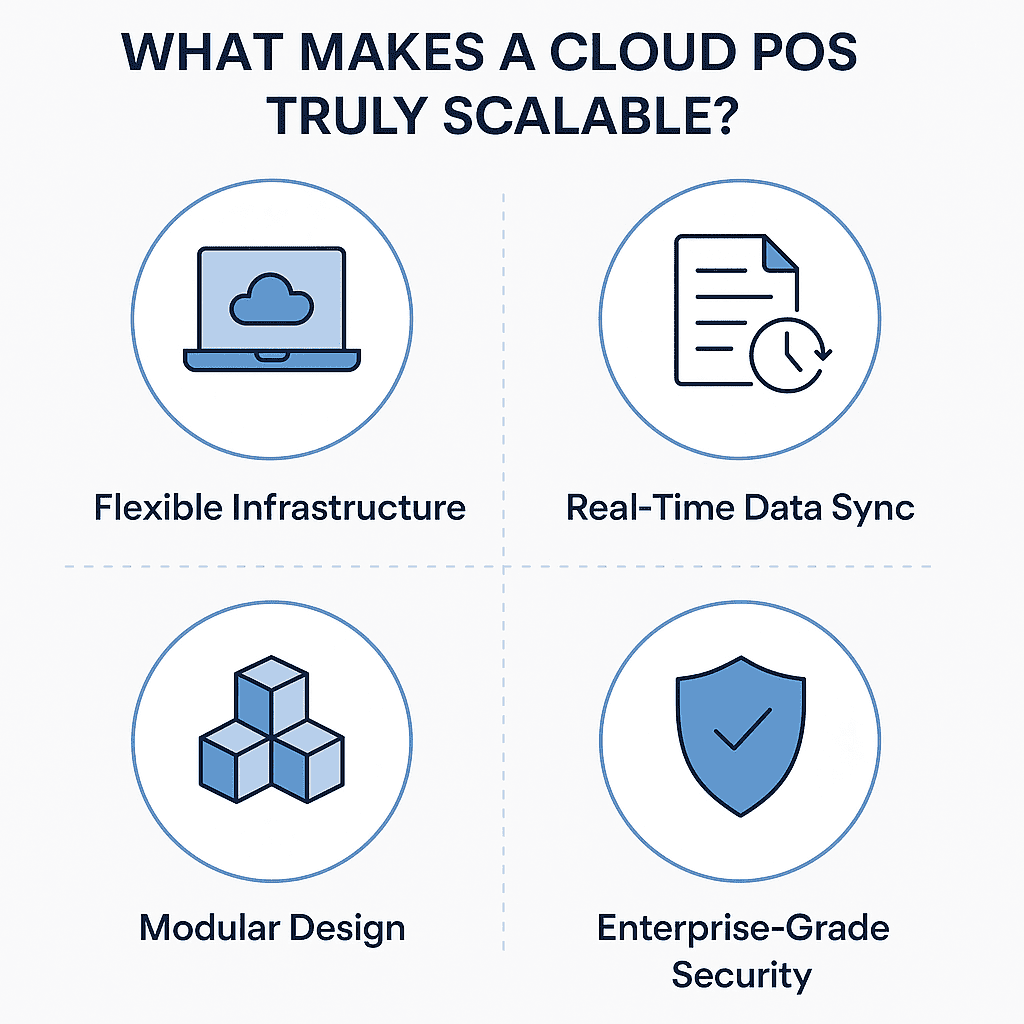
A truly scalable Cloud POS is built on flexible infrastructure, real-time data sync, modular design, and enterprise-grade security, all while maintaining a seamless user experience across every retail touchpoint.
Here’s a quick checklist to assess if your Cloud POS is built for scale:
- Is it built on microservices or modular architecture?
- Can it scale horizontally with growing demand?
- Does it offer real-time data processing across all channels?
- Is it secure, compliant, and optimized for global operations?
- Can it integrate effortlessly with your ERP, CRM, and loyalty systems?
If you’re unsure whether your current POS system meets these requirements, it may be time to rethink your infrastructure.
Why Olabi is Built for What’s Next in Retail
Olabi’s Cloud POS is architected to scale, from a single boutique to a nationwide retail chain. With real-time synchronization, robust APIs, and enterprise-grade security baked in, it empowers retailers to grow confidently without being held back by legacy systems.
Schedule a Demo to see how Olabi’s Cloud POS can future-proof your retail operations.
Let’s build a retail stack that scales as fast as your ambitions.
Share This Story, Choose Your Platform!
About the Author: Olabi

