
Olabi Sutras

How to Create a Standardized GRN Process Across All Stores.
A Goods Received Note (GRN) is one of the most critical checkpoints in retail operations. It is the moment where the physical flow of goods meets the digital record, ensuring that what a store receives matches what was ordered. A well-executed GRN process establishes inventory accuracy, keeps store operations running smoothly, and prevents mistakes from spilling into sales, replenishment, and finance.
However, many retailers still struggle with inconsistent GRN practices across stores. When each location follows its own version of the process, different checks, different timelines, or different levels of documentation, errors multiply quickly. These inconsistencies lead to stock variances, incorrect available quantities, delays in updating systems, and even financial leakage from unreported shortages or supplier discrepancies.
For multi-store retailers, the impact is amplified. Without a standardized GRN process, maintaining a single, reliable view of inventory becomes nearly impossible. Decision-making gets slower, exceptions increase, and operational efficiency drops across the chain. Standardizing GRN process across all stores is therefore not just a process improvement, it is a foundational requirement for accurate inventory management, smooth store operations, and scalable retail growth.
What is Goods Received Note (GRN) and Why It Must Be Standardized
A Goods Received Note (GRN) is the formal record created when a store receives stock from a supplier, warehouse, or distribution center. It verifies the quantity and condition of items delivered and confirms whether they match the purchase order (PO) and delivery documentation. In retail, GRN process acts as the first point of validation before products enter the store’s saleable inventory.
Role of GRN in Inventory Accuracy, Stock Visibility, and Order Management
- Inventory Accuracy: GRN process ensures that only verified stock is added to the system. If the physical count, quality, or SKU details don’t match the PO, the discrepancies are recorded immediately, preventing errors from entering the inventory master.
- Stock Visibility: Real-time GRN updates allow store teams, planners, and central operations to know exactly what is available for sale. Accurate stock visibility directly impacts replenishment cycles, transfers, and even e-commerce order fulfillment.
- Order Management: GRN process acts as the link between ordering and receiving. It confirms whether the supplier delivered the right items in the right quantities, enabling correct invoice processing, supplier evaluation, and future order planning.
Problems Caused When Each Store Follows Its Own GRN Method
- Data Inconsistency: When stores use different counting methods, verification steps, or documentation standards, inventory records become unreliable and difficult to reconcile.
- Stock Variance: Missing checks or inaccurate entries create mismatches between system stock and physical stock, leading to stockouts, overstocking, or incorrect availability shown to customers.
- Operational Delays: Inconsistent GRN process timelines slow down stock updates, affecting replenishment, transfers, and omnichannel fulfillment at the store level.
- Financial Leakage: Without uniform checks, shortages, damages, or supplier discrepancies may go unreported, resulting in incorrect payments and avoidable losses.
- Lack of Accountability: Different processes create ambiguity in ownership, making it difficult to trace errors, audit performance, or enforce discipline across stores.
- Training Challenges: Staff moving between stores encounter different GRN expectations, increasing errors and slowing down onboarding.
Common GRN Process Issues Across Retail Stores
Retailers often face recurring GRN challenges that directly affect stock accuracy and operational flow:
Manual errors during item count and verification
Inconsistent counting methods, rushed checks, and human error lead to incorrect item quantities recorded at the time of receipt.
Mismatch between PO, invoice, and physical quantities
Differences between what was ordered, what the supplier billed, and what actually arrived cause reconciliation issues and approval delays.
Delays in updating systems
When GRNs are entered late or stored offline, stock availability shown in the system becomes unreliable, impacting replenishment and sales.
Missing documents and lack of approvals
Stores may fail to file invoices, delivery challans, or approval notes properly, resulting in no audit trail and disrupted financial processes.
Supplier-related discrepancies
Shortages, excess quantities, damaged goods, or incorrect items requires immediate recording, but inconsistent GRN practices often miss these details.
Key Components of a Standardized GRN Process
A unified GRN framework ensures every store follows the same steps, uses the same documents, and maintains the same accuracy levels. The core elements include:
Standard GRN Checklist for All Stores
A uniform checklist that outlines required documents, verification steps, quantity checks, condition checks, and recording guidelines ensures consistency across locations.
Mandatory Steps for Item Verification
Every store must follow a fixed sequence: verify SKU codes, count quantities, check expiry or MRP (if applicable), inspect product condition, and validate supplier details before accepting goods.
Document Flow (PO → Delivery Note → Invoice → GRN)
A structured document flow prevents confusion. Stores must match every received shipment with its Purchase Order, validate it against the Delivery Note, cross-check with the Invoice, and finally create the GRN.
Standard Tolerances for Shortages and Damages
Pre-defined tolerance limits for acceptable shortages, overages, or damages help avoid case-by-case decisions and ensure uniform supplier handling.
Defined Timelines for GRN Completion
GRNs must be completed and updated in the system within a fixed timeframe (e.g., within the same day or within 2 hours of receipt) to maintain real-time stock accuracy.
Role-Based Responsibilities
Clear ownership ensures accountability. Store staff must have defined responsibilities such as who checks quantities, who enters data in the system, who approves exceptions, and who communicates discrepancies to suppliers.
Step-by-Step Standard GRN Workflow
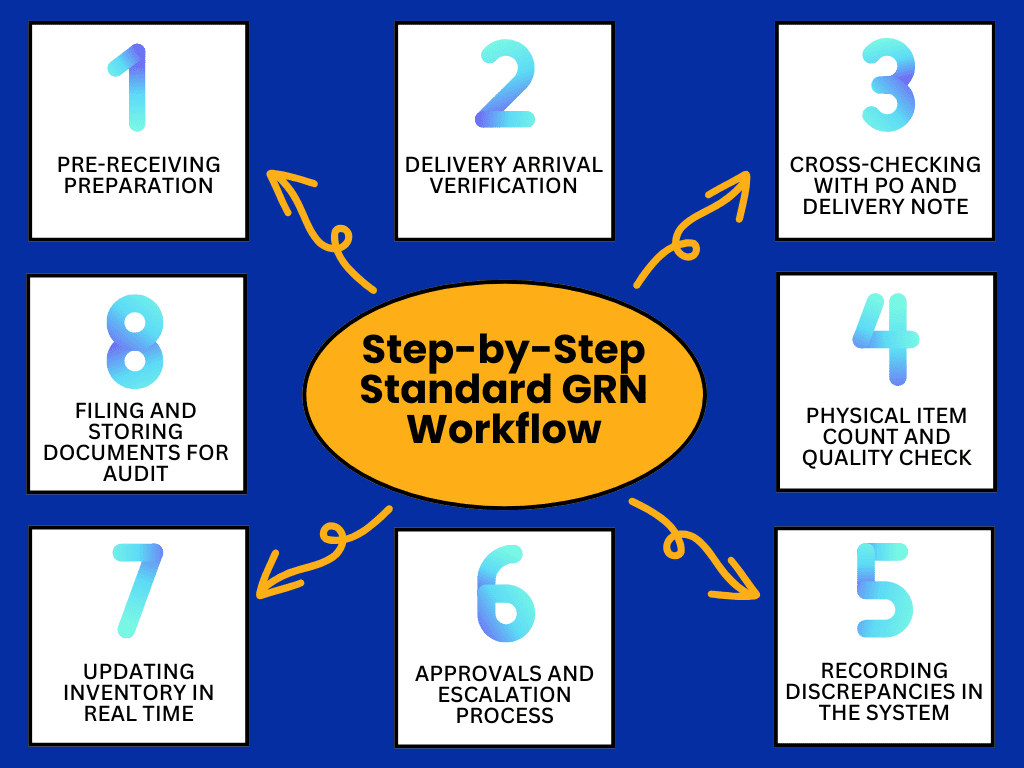
A standardized GRN process workflow ensures every store follows the same sequence from receiving goods to updating inventory. The essential steps include:
Pre-Receiving Preparation
Stores must ensure receiving areas are clean, organized, and equipped with necessary tools, scanners, weighing scales, GRN forms, and access to the system, before any delivery arrives.
Delivery Arrival Verification
The first checkpoint is confirming the supplier name, shipment details, vehicle info, and delivery timing. This step ensures that the store is receiving the correct consignment.
Cross-Checking with PO and Delivery Note
Store staff must match the shipment against the Purchase Order and Delivery Note. Any mismatch in SKU codes, quantities, or descriptions must be identified before accepting the goods.
Physical Item Count and Quality Check
Items should be counted accurately and inspected for damage, leakage, expiry, tampering, incorrect labelling, or packaging issues. This prevents bad stock from entering the system.
Recording Discrepancies in the System
Any shortages, excess quantities, or damaged goods must be logged immediately. This ensures transparency and prevents future disputes or stock adjustments.
Approvals and Escalation Process
Discrepancies should be routed for supervisor approval. Major exceptions, like high-value shortages or repeated supplier issues, must follow an escalation workflow to the central operations or procurement team.
Updating Inventory in Real Time
Once verification is complete, the GRN process should be closed and inventory updated instantly. This ensures accurate stock visibility for replenishment, online orders, and sales planning.
Filing and Storing Documents for Audit
All related documents, PO, Delivery Note, Invoice, GRN, must be stored digitally or physically as per company policy. A proper audit trail helps during reconciliations, supplier disputes, and compliance checks.
Using Technology to Standardize GRN
Technology plays a critical role in eliminating inconsistencies and ensuring every store follows the same GRN workflow. Key technology enablers include:
Mobile GRN Apps to Replace Paper-Based Processes
Mobile-based receiving tools ensure store staff follow a guided, step-by-step GRN workflow. This eliminates handwritten entries, reduces errors, and speeds up the receiving process.
Barcode/QR Scanning to Reduce Manual Entry
Scanning SKUs directly from product labels or cartons ensures accurate item recognition, faster verification, and minimal manual typing, leading to fewer errors and higher efficiency.
Automated Matching of PO, Invoice, and Delivery Note
System-driven matching helps identify mismatches instantly. When PO line items, invoice quantities, or delivery note details do not match, the system flags it, saving time and preventing incorrect GRNs.
Real-Time Alerts for Variances, Shortages, or Damages
Automated alerts notify store managers and central teams immediately when something deviates from expected quantities or quality standards. This improves visibility and speeds up decision-making.
Centralized Dashboards for Tracking GRN Quality Across Stores
Regional managers and HO teams can monitor GRN performance, exception rates, and delays across all stores. This helps identify problem locations and improve process adherence.
Audit Logs for Compliance and Accountability
Every action, who received goods, who verified quantities, who approved discrepancies, is recorded in the system. This provides complete transparency, strengthens compliance, and supports supplier dispute resolution.
Training and Governance for Store Teams
A standardized GRN process is only effective when store teams are trained, aligned, and consistently monitored. Strong training and governance frameworks ensure every store executes GRN accurately, regardless of staff changes or operational pressures.
Standard GRN Training Modules for New Staff
Every new employee involved in receiving must undergo structured onboarding that covers GRN steps, documentation, verification rules, and system usage. This ensures uniform understanding across all stores.
Periodic Refreshers and Assessments
Regular refresher sessions help reinforce correct practices and reduce process deviations. Short assessments or audits can be used to identify gaps and retrain staff when required.
Clear Ownership: Store Manager vs. Receiving Staff
Defined roles eliminate confusion. Receiving staff handle physical verification and system entry, while the store manager oversees approvals, exceptions, and escalation handling.
GRN Performance Metrics for Stores
KPIs such as GRN completion time, discrepancy rates, delay frequency, and audit compliance help evaluate store-level performance and highlight locations needing corrective action.
How SOP Governance Maintains Process Discipline
Documented SOPs ensure all stores follow the same workflow. Governance mechanisms, spot checks, internal audits, exception reviews, and digital logs, keep the process consistent and disciplined.
How a Standardized GRN Process Benefits Retailers
A unified and consistent GRN process delivers measurable improvements across store operations, inventory management, and supplier relationships. Key benefits include:
Higher Inventory Accuracy Across All Stores
When every store follows the same GRN steps, discrepancies reduce significantly. Accurate quantities flow into the system, strengthening overall stock visibility.
Reduced Shrinkage and Fewer Stock Mismatches
Standardized checks help identify shortages, damages, and incorrect deliveries upfront. This prevents hidden shrinkage and reduces the need for frequent stock adjustments.
Faster Receiving and Reduced Staff Workload
A clear, guided workflow speeds up the receiving process. Staff spend less time verifying items manually, allowing them to focus more on customer-facing tasks.
Improved Replenishment and Fewer Stockouts
With accurate GRN data, replenishment planning becomes more reliable. HO teams can allocate inventory more precisely, reducing stockouts and improving on-shelf availability.
Better Supplier Accountability
Documented discrepancies, real-time variance tracking, and consistent tolerances make it easier to hold suppliers accountable for shortages and damages.
Smoother Omnichannel Fulfillment Through Accurate Stock Data
Omnichannel operations depend on real-time, accurate inventory. A standardized GRN ensures that stock levels reflect what is actually available, reducing order cancellations and improving customer experience.
Conclusion
A standardized GRN process is essential for retailers who aim to scale efficiently and maintain operational consistency across multiple stores. By ensuring every location follows the same steps, from receiving to verification to system updates, retailers eliminate ambiguity, reduce shrinkage, and strengthen inventory accuracy at the foundation level.
Consistency in GRN process does more than improve store operations; it enhances the entire retail supply chain. Accurate incoming data enables better forecasting, smoother replenishment, stronger supplier relationships, and more reliable omnichannel fulfillment.
For retailers looking to build resilient operations, the next step is clear: adopt structured GRN workflows supported by digital tools that automate checks, guide staff, and provide real-time visibility. Standardization today leads to scalability tomorrow.
To streamline your GRN process and improve overall retail operations, schedule a demo with Olabi and see how our platform brings accuracy, speed, and control to every store.
Share This Story, Choose Your Platform!
About the Author: Olabi

