
Olabi Sutras
How Modern Retail Platforms Handle SKU Variants, Kits, and Bundles at Scale
A single product isn’t always just a single SKU. It might come in five sizes, ten colors, or multiple configurations, each requiring distinct inventory tracking, pricing, and fulfillment rules. Add pre-defined kits or dynamic bundles into the mix, and product management quickly becomes a complex challenge for retail businesses operating at scale.
Retail teams need systems that can not only support this complexity but make it manageable and scalable. From product master structuring to inventory logic and order processing, modern retail platforms are designed to handle SKU variants, kits, and bundles in a way that’s both efficient and channel-agnostic.
In this blog, we unpack how these platforms are architected to manage such product complexity, covering everything from backend data models and stock control mechanisms to frontend experience and reporting insights.
Understanding the Basics
a. What Are SKU Variants?
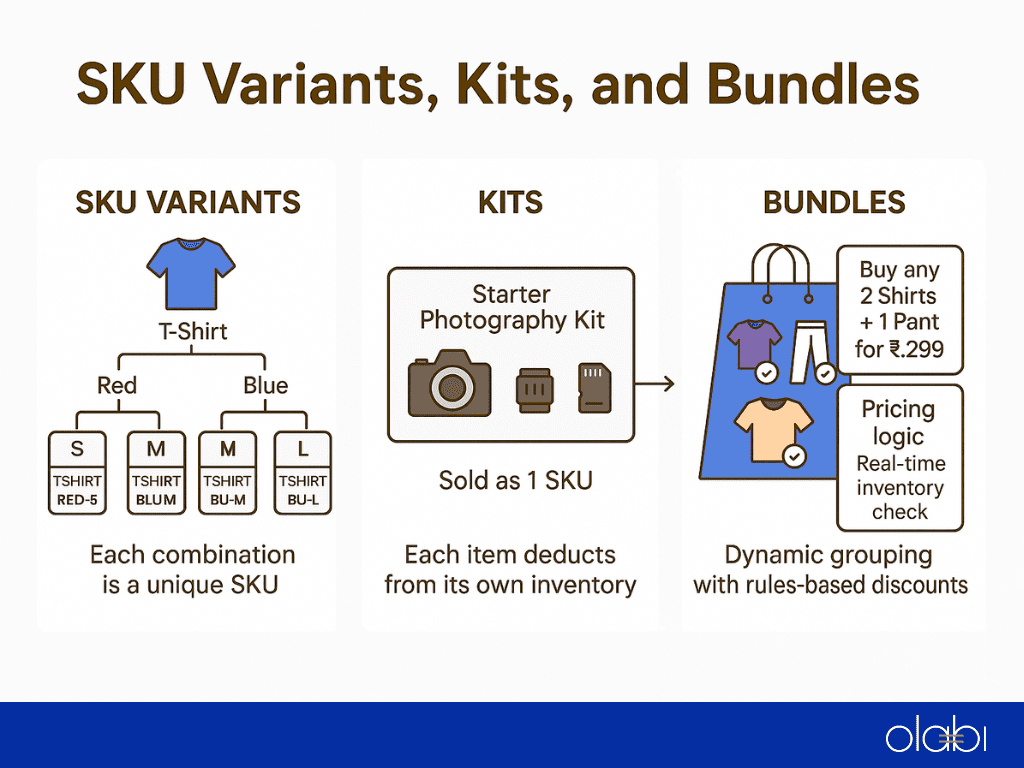
SKU variants refer to multiple versions of the same base product, distinguished by attributes like size, color, fit, material, or style. While the core product remains the same, each combination of attributes is treated as a distinct SKU in the system.
Example:
A t-shirt available in 3 sizes (S, M, L) and 4 colors results in 12 unique SKUs.
Functional Requirements:
- Unique identification: Each variant needs a unique barcode or SKU code.
- Inventory tracking: Stock levels must be tracked individually per variant.
- Flexible pricing: Pricing may vary across certain variants (e.g., larger sizes may cost more).
Accurate variant management ensures customers see only what’s in stock, reduces fulfillment errors, and enables better demand forecasting.
b. What Are Kits?
Kits are pre-assembled combinations of multiple SKUs sold together as a single unit. Unlike bundles, kits are typically fixed in composition and are treated as one product from a sales and billing perspective, while still maintaining links to the inventory of individual components.
Example:
A “starter photography kit” containing a DSLR camera, lens, memory card, and tripod.
Functional Requirements:
- Parent-child relationship: The kit functions as a parent SKU, linked to multiple child SKUs.
- Inventory logic: Stock deduction occurs for each individual item when a kit is sold.
- Centralized management: Kits must reflect accurate availability based on the stock status of each included SKU.
Proper kit handling allows for smoother packaging, better marketing of bundles, and inventory-aware selling.
c. What Are Bundles?
Bundles are combinations of individual SKUs offered together, either as promotions or customizable sets but unlike kits, they may be dynamically created or adjusted by the customer or store. Bundles often use conditional logic to apply special pricing or benefits.
Example:
“Buy any 2 shirts + 1 pant for ₹2,999” or a “Mix & Match” fashion bundle where the user selects preferred styles.
Functional Requirements:
- Dynamic pricing engine: The system must support rule-based pricing and discount application.
- Real-time inventory validation: Each item in the bundle must be available in the required quantity.
- Flexible configuration: Customers may be allowed to choose from eligible items to create the bundle.
Effectively managing bundles increases average order value (AOV), supports promotional strategies, and requires tight coordination between product, pricing, and inventory systems.
Tech Stack Required for Modern Retail Platforms to Manage Them at Scale
Managing SKU variants, kits, and bundles at scale requires a robust and flexible technology foundation like modern retail platforms. From how data is structured in the backend to how it’s presented on the frontend, every layer of the retail stack plays a critical role in ensuring consistency, accuracy, and performance across all sales channels.

a. Product Master Design
At the core of any scalable retail system is a well-structured product master. It defines how products, variants, and SKUs are organized, stored, and retrieved.
Key Elements:
- Hierarchical structure: Products are structured in levels, typically Product → Variant → SKU. This allows clean separation between the parent product and its attribute-based variants.
- Attribute grouping and inheritance: Common attributes (brand, category) are inherited by all variants, while unique attributes (size, color, fit) differentiate SKUs.
- Template-driven setup: Predefined templates ensure standardized creation of product families, reducing manual effort and minimizing errors when handling large catalogs.
This structure forms the foundation for inventory tracking, pricing, and omnichannel consistency.
b. SKU Identification & Mapping
Each SKU needs a unique identity across systems and channels. Without consistent identifiers, inventory mismatches, fulfillment issues, and reporting errors are inevitable.
Key Elements:
- Unique identifiers: Barcodes, internal SKU codes, and GTINs are essential for identifying and tracking each variant individually.
- Cross-channel mapping: SKUs must be mapped accurately across in-store POS, ecommerce platforms, warehouses, and third-party marketplaces.
- System interoperability: The ability to sync SKU data across multiple systems, ERP, OMS, WMS, and CRM is crucial for real-time operations.
This mapping ensures that every SKU behaves consistently no matter where it appears or how it’s sold.
c. Kit/Bundling Logic in the Backend
Kits and bundles require additional logic in the backend to manage virtual groupings, pricing rules, and inventory dependencies.
Key Elements:
- Virtual SKUs: Kits are often represented as virtual SKUs that link to multiple real SKUs, enabling centralized promotion and reporting.
- Stock deduction rules: Platforms must determine whether to deduct inventory at the kit level or from individual components based on fulfillment strategy.
- Availability syncing: A kit’s availability must reflect the lowest stock level among its components, requiring real-time synchronization with child SKU inventories.
This logic helps maintain inventory integrity while offering flexible merchandising options.
d. UI/UX Layer Considerations
The way SKU variants, kits, and bundles are displayed and interacted with plays a major role in conversion and customer satisfaction.
Key Elements:
- Variant selectors: Dropdowns, swatches, or visual grids allow users to easily choose sizes, colors, or styles, powered by real-time stock visibility.
- Bundle builders: Dynamic interfaces let customers customize bundles based on available options, often with live price updates.
- Personalized recommendations: Platforms can use shopper behavior to suggest bundles or variant preferences, enhancing both experience and cart value.
A strong frontend experience built on accurate backend data ensures shoppers get the right product, in the right configuration, every time.
Inventory and Order Management Implications
Managing SKU variants, kits, and bundles extends far beyond catalog structure and frontend experience. It has deep implications for how inventory is tracked, how orders are fulfilled, and how performance is measured. At scale, modern retail platforms must account for complex inventory dependencies and fulfillment workflows while ensuring real-time accuracy and visibility.
a. Real-Time Inventory Sync
Accurate inventory management starts with real-time visibility, especially when a single parent product maps to multiple variants or when kits and bundles share underlying SKUs.
Key Considerations:
- Variant-level stock impact: Selling one variant should not affect the availability of others unless stock is shared. For example, a “Red Shirt – Size M” going out of stock must not impact “Red Shirt – Size L.”
- Composite stock logic for kits/bundles: The availability of a kit or bundle depends on the stock status of all its components. If even one item is unavailable, the entire bundle must be marked out of stock.
- Oversell prevention: During flash sales or high-traffic periods, platforms must sync inventory across channels in near real-time to avoid overselling and order cancellations.
Real-time sync is crucial to ensuring that what the customer sees is exactly what the store can fulfill, especially in an omnichannel environment.
b. Order Routing & Fulfillment
Kits and bundles often involve multiple SKUs, which may be stored across different locations. The fulfillment engine must be able to break down orders and route them intelligently.
Key Considerations:
- Split order logic: A single bundle might need to be fulfilled from multiple warehouses or stores based on availability. The platform must support automatic order splitting and aggregation.
- Partial fulfillment rules: If only some items in a bundle are available, systems need to define whether to ship partially, wait for restocking, or cancel altogether, depending on business policy.
- Returns handling: Returns must be traceable at the individual SKU level, even if the item was sold as part of a kit or bundle. Systems must support disaggregation and restocking logic accordingly.
A robust fulfillment engine is essential for maintaining customer trust and operational efficiency.
c. Reporting & Reconciliation
Product performance, profitability, and inventory planning all rely on clear, granular reporting, especially when dealing with variant-heavy catalogs and bundled offerings.
Key Considerations:
- Sales tracking by hierarchy: Platforms must allow reporting at all levels, parent product, individual variant, and bundled SKU to understand what’s truly driving revenue.
- Profitability of kits/bundles: Bundles may be priced differently than the sum of their parts. Platforms should be able to attribute revenue and cost to individual components for accurate margin analysis.
- Demand forecasting: High-volume bundles require predictive analysis to forecast demand not just for the bundle itself, but for each underlying SKU. This enables smarter procurement and replenishment planning.
Comprehensive reporting helps retailers optimize product strategy, reduce deadstock, and increase profitability.
Challenges in Scale and How Modern Platforms Solve Them
Managing SKU variants, kits, and bundles becomes increasingly complex as retail businesses grow. Without the right systems, the very tools meant to enhance customer experience and merchandising flexibility can lead to operational inefficiencies, fulfillment delays, and data inconsistencies. Modern retail platforms are designed to address these challenges with built-in automation, intelligent logic, and scalable architecture.
a. Catalog Explosion
As product offerings expand, a few base products can quickly multiply into thousands of SKUs due to variants and kits. Managing such a large catalog manually is inefficient and error-prone.
How Modern Platforms Solve It:
- Template-driven product creation: Merchandisers can use predefined templates to quickly generate variants based on common attributes.
- Bulk operations and imports: Modern systems allow for batch uploads, mass edits, and rule-based generation of SKUs.
- Smart grouping: Platforms group variants logically under parent products, making catalog navigation and management more intuitive.
By automating repetitive tasks, platforms reduce manual effort and ensure consistency across the catalog.
b. Dynamic Pricing & Promotions
Retailers often run bundle-specific discounts, mix-and-match offers, or location-specific pricing. Keeping these dynamic pricing strategies aligned with inventory logic can be a challenge.
How Modern Platforms Solve It:
- Integrated promotion engines: Platforms support rule-based pricing that adapts in real-time based on bundle composition, channel, or customer profile.
- Real-time recalculations: As customers modify bundles or select different variants, pricing updates instantly while maintaining inventory integrity.
- Stackable logic support: Systems allow multiple offers to apply conditionally without conflicting with each other.
This ensures pricing agility without compromising backend control.
c. Omnichannel Consistency
Customers expect a unified experience across online, in-store, and mobile. Disjointed SKU definitions, stock visibility gaps, or inconsistent bundling logic can create friction and erode trust.
How Modern Platforms Solve It:
- Unified SKU architecture: SKUs are centrally managed and reflected consistently across all channels.
- Shared inventory view: Platforms provide a single source of truth for availability, enabling accurate stock visibility for Endless Aisle, ecommerce, and in-store POS.
- Offline-ready kits and bundles: Store systems are capable of handling pre-configured kits even in low or no connectivity scenarios, ensuring a consistent experience everywhere.
True omnichannel success starts with unified data and ends with seamless execution.
How Olabi Does It Differently
Olabi is built for the needs of fashion and lifestyle retail, where variant complexity, promotional agility, and omnichannel expectations are the norm. Here’s how Olabi approaches SKU management at scale:
- Proprietary SKU Engine: Designed to handle deep hierarchies and complex attribute combinations across apparel, accessories, and seasonal drops.
- Visual Bundling Tools: Merchandisers can create and preview kits or promotional bundles with real-time inventory and pricing validations.
- Real-Time Inventory Sync: Olabi ensures variant-level stock updates across all sales channels, integrated with its Endless Aisle and POS modules for unified availability.
- Promotion-Integrated Logic: Bundles, offers, and price rules are deeply connected to SKU and inventory logic, enabling agile yet reliable campaign rollouts.
Olabi simplifies what most platforms complicate, offering retailers both control and flexibility at scale. Schedule a demo with our team today to explore more.
Conclusion
Managing SKU variants, kits, and bundles isn’t just about organizing products, it’s about enabling operational efficiency, driving smarter merchandising decisions, and delivering consistent customer experiences across every channel. As product complexity grows, so does the need for systems that can support it without slowing down business.
Modern retail platforms address this challenge with robust product master structures, real-time inventory logic, dynamic pricing engines, and unified omnichannel architecture. When implemented correctly, they empower retailers to scale confidently, launch campaigns faster, and maintain full control over their catalog, no matter how complex it becomes.
For brands looking to future-proof their operations, choosing the right technology partner is key. Whether it’s variant-rich assortments or high-volume promotional bundles, your platform needs to do more than just support, it needs to simplify.
Share This Story, Choose Your Platform!
About the Author: Olabi

